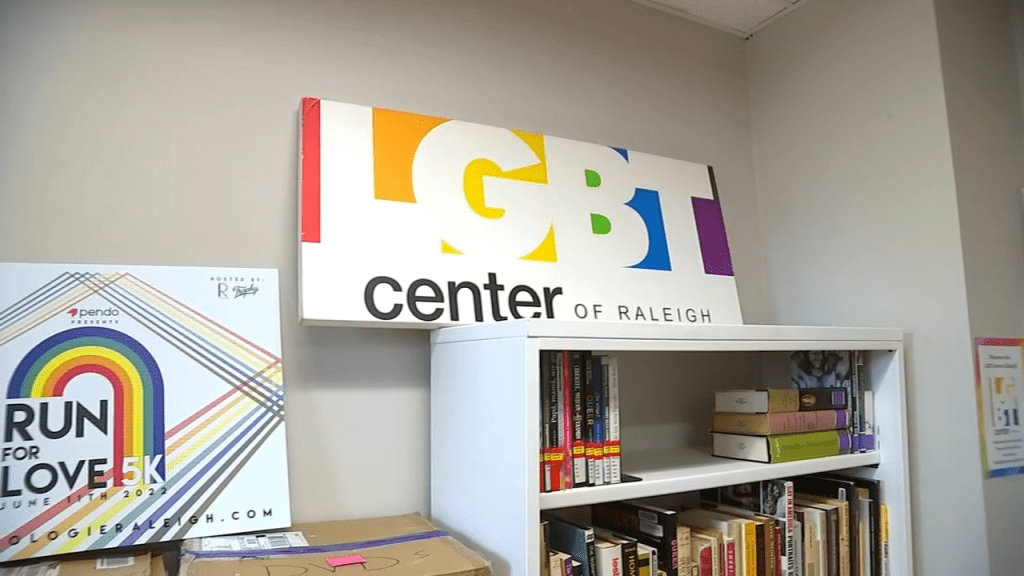
Raleigh leaders are embarking on a special effort to document historic and significant LGBTQ sites around the city.
On Monday night, a consultant hired by the city presented a study of those places, as well as recommendations on the locations that should be given an historic designation.
Over 250 properties have been identified.
Willie Pilkington, a resident in Raleigh said we all have something to contribute.
“When you see a marker, and if it’s a gay, lesbian, bisexual and transgender reference point, then that’s just one more ‘ah ha’,” he said. “This is who those people are. This what they actually did…and that’s what those markers do.”
City leaders said the effort is a step in preserving the stories and history of the LGBTQ community.
A surge of grant cancellations hit researchers focused on the health of gay, lesbian and transgender people last week, as the Trump administration continues to target what it describes as ideologically driven science.
Last week the U.S. government terminated at least 68 grants to 46 institutions totaling nearly $40 million when awarded, according to a government website. Some of the grant money has already been spent, but at least $1.36 million in future support was yanked as a result of the cuts, a significant undercount because estimates were available for less than a third of grants.
Most were in some way related to sexual minorities, including research focused on HIV prevention. Other canceled studies centered on cancer, youth suicide and bone health.
Health and Human Services spokesman Andrew Nixon said the agency is “dedicated to restoring our agencies to their tradition of upholding gold-standard, evidence-based science.” The grants were awarded by the National Institutes of Health, an agency under HHS.
One canceled project at Vanderbilt University had been following the overall health of more than 1,200 LGBTQ people age 50 and older. Most of the money has been spent from the grant funding the project, but it was up for renewal in April, said Tara McKay, who leads Vanderbilt’s LGBTQ+ Policy Lab.
She said the grant won’t be renewed because of the termination, which jeopardizes any long-term results. Still, the Vanderbilt project had already generated two dozen published papers, including work used to train doctors to provide better care to LGBTQ people, increasing the likelihood of cancer screenings and other preventive care.
“That saves us a lot of money in health care and saves lives,” McKay said.
Insights from minority populations can increase knowledge that affects everyone, said Simon Rosser, who studies cancer in gay and bisexual men at the University of Minnesota.
“We now no longer have anywhere studying LGBT cancer in the United States,” said Rosser, who saw his grants canceled on Friday.
“When you decide to cancel all the grants on sexual minorities, you really slow down scientific discovery, for everyone,” Rosser said. Young researchers will lose their jobs, and the field as a whole will suffer, he added.
“It’s a loss of a whole generation of science,” Rosser said.
Termination letters seen by The Associated Press gave as reasons that the research was “unscientific” or did “nothing to enhance the health of many Americans.”
That language felt personal and stinging, McKay said.
“My project’s been accused of having no benefit to the American people. And, you know, queer and trans folks are Americans also,” McKay said.
The State Department has not commented a report that indicates it plans to remove LGBTQ-specific information from their annual human rights report.
Politico on March 19 reported the Trump-Vance administration “is slashing the State Department’s annual human rights report — cutting sections about the rights of women, the disabled, the LGBTQ+ community, and more.” The Politico article notes it obtained “documents” and spoke with “a current and a former State Department official who were familiar with the plan.”
“We are not previewing the human rights report at this time,” a State Department spokesperson told the Washington Blade on March 21.
Congress requires the State Department to release a human rights report each year.
The 2023 report specifically noted Uganda’s Anti-Homosexuality Act that contains a death penalty provision for “aggravated homosexuality.” The 2022 report highlighted, among other things, anti-LGBTQ crackdowns in Afghanistan, Russia, and Hungary and so-called conversion therapy.
President Donald Trump since he took office has signed a number of executive orders that have specifically targeted the LGBTQ and intersex community. These include the “Defending Women from Gender Ideology Extremism and Restoring Biological Truth to the Federal Government” directive that, among other things, bans the State Department from issuing passports with “X” gender markers.
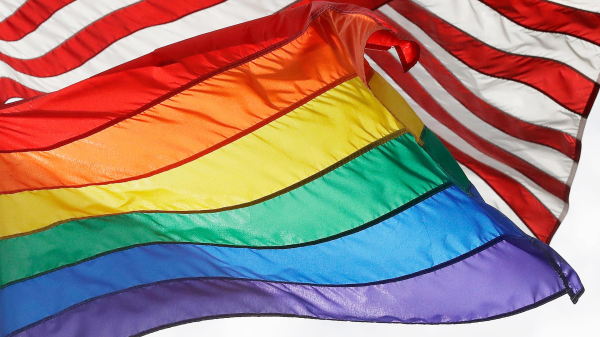
A directive that Secretary of State Marco Rubio issued bans embassies and other U.S. diplomatic institutions from flying the Pride flag. (Former President Joe Biden in March 2024 signed a government spending bill with a provision that banned Pride flags from flying over U.S. embassies.)
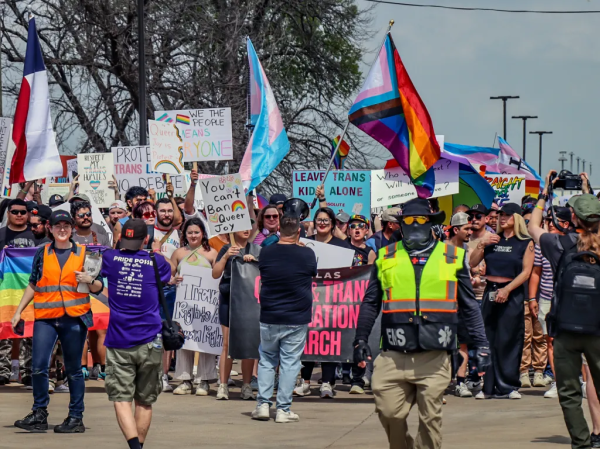
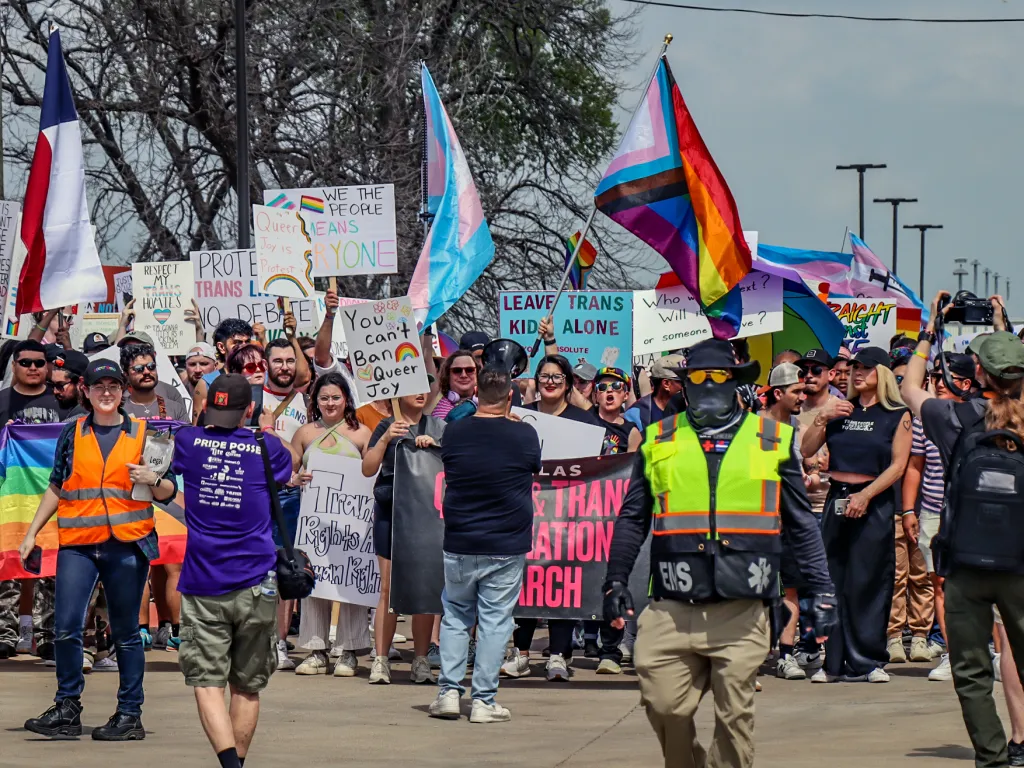
Several hundred people crowded into the parking lot between Cathedral of Hope and Resource Center on Sunday afternoon for a short rally before pouring out onto Cedar Springs Road and marching to The Crossroads.
The March for Queer & Trans Liberation, organized by a coalition of more than 20 local organizations with GLAAD’s Texas representative and communications director for Texas Latino Pride Jacob Reyes, was held in response to the ongoing wave of anti-LGBTQ legislation and policies coming out of Washington, D.C., and state Capitols around the country, including Austin where Texas lawmakers this session have introduced a record number — 205 — of anti-LGBTQ bills, especially focusing on anti-trans efforts.
In explaining the reasons last week for the march, Cece Cox, CEO for Resource Center which was one of the organizations behind the march said, “The Queer & Trans Liberation March sends a message to all in Dallas and across Texas that when we stand up and show up for our communities, we move closer to reclaiming justice.’
*The below is part of a larger report from Ohio’s NBC4.
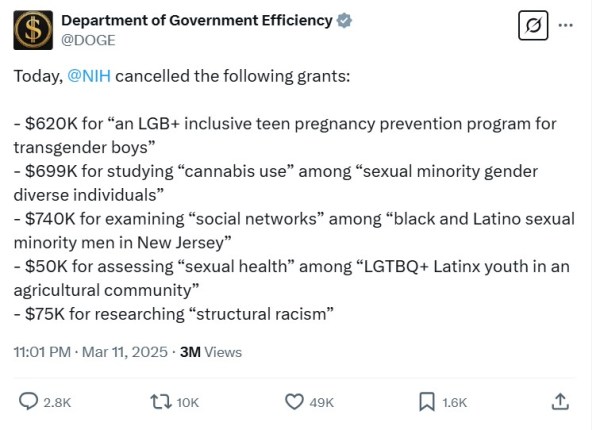
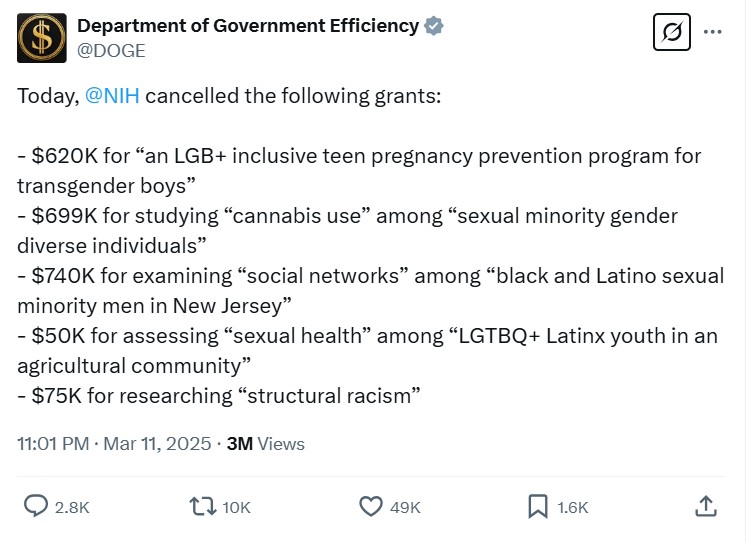
Nearly $2.2 million worth of grant funding for university research was cancelled earlier this month by the NIH at the behest of DOGE. The majority of the funding dealt with the LGBTQ community. The remainder was specific to structural racism.
The report of course stems from a post on X by DOGE “itself”. The news article does confirm the cancellation of the cannabis use study funding. Others have not been independently verified as having been cancelled.
The New Hampshire House of Representatives voted 201-166 today to advance a bill that would strip rights of LGBTQ+ residents of the Granite State, with particular harm to transgender people.
HB 148 would roll back some of the gender discrimination protections passed in 2018, opening the door to discrimination in public spaces, including bathrooms. The bills now move to the Senate. In 2018, New Hampshire became the first U.S. state to pass an update to its anti-discrimination law to include transgender people through a fully Republican-controlled House, Senate, and Governor’s office. A bill similar to HB 148 ( HB 396 ) to roll back gender discrimination protections was vetoed by Governor Sununu last year.
Advocates for LGBTQ+ rights, public education, and child welfare issued the following statements:
Linds Jakows, founder of 603 Equality, said: Make no mistake: The majority of New Hampshire state representatives said loud and clear today that they intend to use the law to keep transgender and gender non-conforming people out of public life. This was never about bathrooms or parental rights. It is about using the power of the state to deny basic freedoms and control our bodies and lives. Transgender and gender non-conforming people are powerful and loved, and the overwhelming majority of witnesses and New Hampshire residents who signed to oppose these bills will continue to fight for freedom and safety.
Heidi Carrington Heath, executive director of NH Outright, said: LGBTQ+ youth in New Hampshire have the right to access all the spaces and places they need to thrive. They deserve to hear loud and clear from government that they are valued citizens of the Granite State. Transgender youth are a deeply vulnerable population, and today’s vote on HB148 only causes them further harm. This is not the way to live free or die. To our LGBTQ+ youth, especially transgender youth, we will continue to fight and work for a New Hampshire that reflects their inherent worth and dignity.
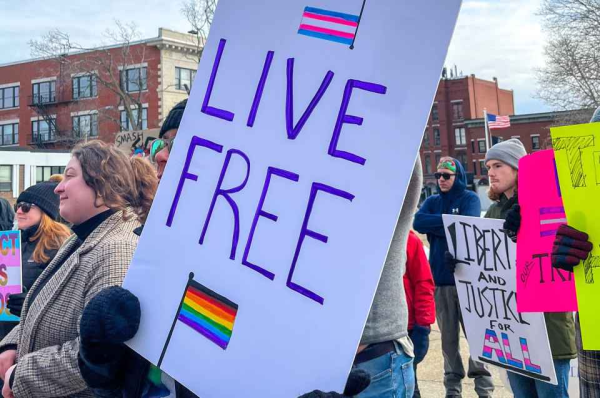
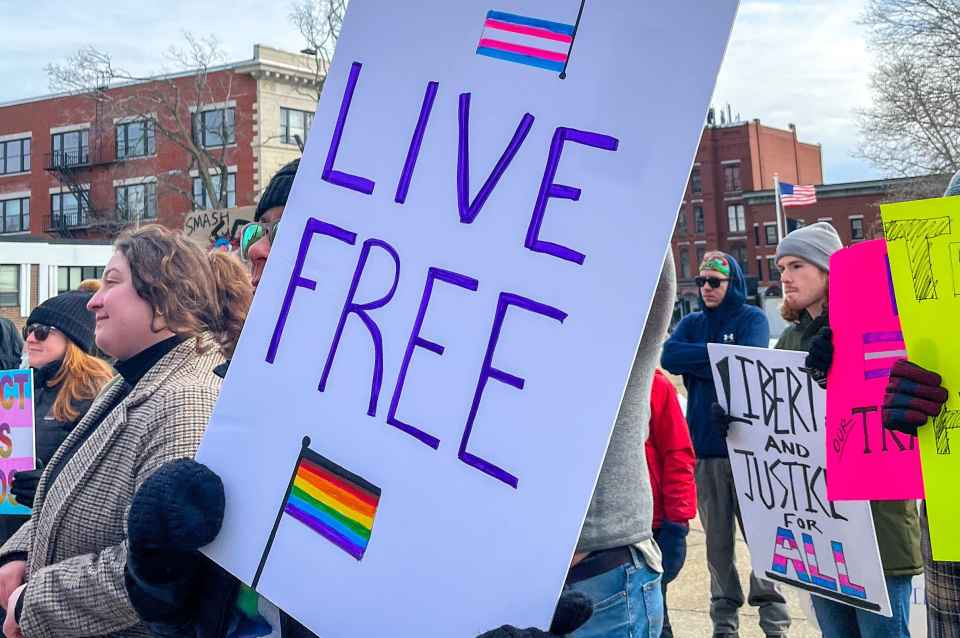
Chris Erchull, senior staff attorney at GLBTQ Legal Advocates & Defenders (GLAD Law), said: “ It is disheartening that members of the House of Representatives voted to strip away important protections for the Granite State’s LGBTQ+ community, especially for transgender residents, who are our friends, neighbors, and coworkers. Senators should reject this mean-spirited bill, which is part of a broader effort by local and national governments to prevent transgender people from simply being able to go about their daily lives. Lawmakers should work to improve the lives of all New Hampshire residents instead of passing an unnecessary law that discriminates against already vulnerable people and makes them even more unsafe. Respecting New Hampshire’s values of liberty and justice means we cannot tolerate any legislation that attacks people simply for who they are and declares them unworthy of protections from discrimination.”
Courtney Reed, policy advocate for the ACLU of New Hampshire, said: “ It is unacceptable to allow discrimination against LGBTQ+ people in New Hampshire legislation, but that is precisely what HB 148 would do. We urge the Senate to oppose this dangerous bill, which would undermine the right to equal protection under the law for transgender people. Our state has a proud tradition of respecting the rights of LGBTQ+ people, and it is time to make that clear once again.”
Devan Quinn, policy director for the New Hampshire Women’s Foundation , said, “Transgender, non-binary, and intersex people deserve equal treatment in schools, sports, correctional facilities, and every other aspect of public life. These laws will roll back the progress New Hampshire has made in recognizing transgender people in anti-discrimination legislation. Transgender women are women, and trans girls are girls. Like all women and girls, they deserve fair treatment in every aspect of their lives.”
Louise Spencer, Kent Street Coalition , said, “Transgender, non-binary, and intersex people are residents of the Granite State and deserve the same rights, freedom, and opportunities as anyone else here in the Live Free or Die state. For a majority of lawmakers to vote for a bill that denies our neighbors, friends, and families equality under the law is a betrayal not only of what New Hampshire stands for, but more importantly, a betrayal of the people and communities who deserve our unconditional support and respect. We urge the Senate to oppose this bill, which violates the humanity and dignity of LGBTQ+ people.”
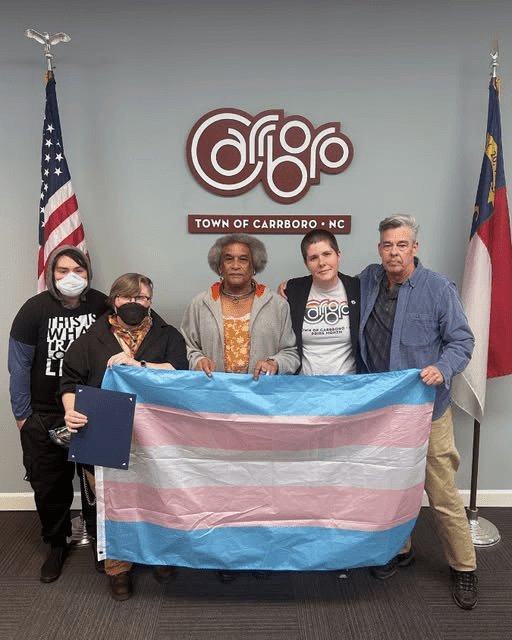
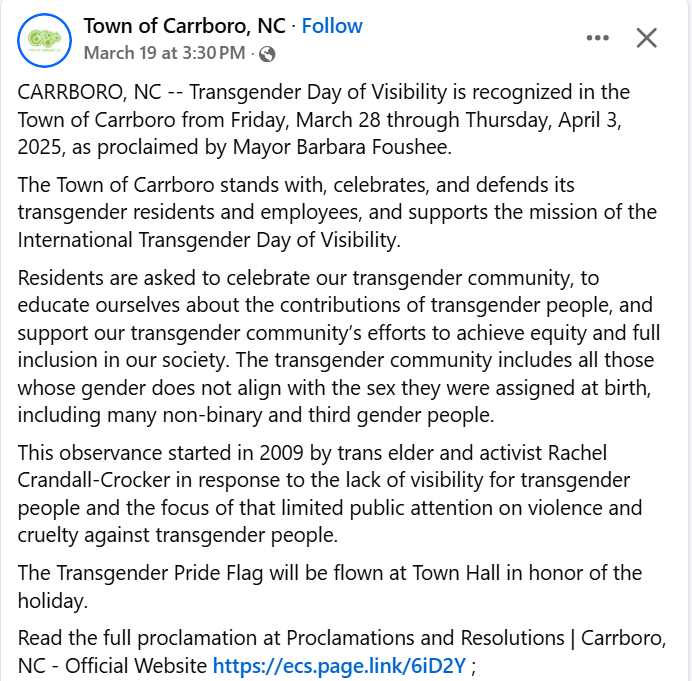
Carrboro, the small sister town of Chapel Hill NC, officially recognizes Transgender Day of Visibility. Carrboro’s welcomeness is well known, and elected the first openly gay mayor in the state back in 1995. The proclamation was read by Councilmember Catherine Fray, the first openly non binary person elected to office in NC.
Denmark is advising its transgender and nonbinary citizens to proceed with caution when traveling to the U.S., according to a new advisory.
An update made Thursday to the Danish foreign ministry’s webpage on travel to the U.S. recommends trans people contact the U.S. embassy in Copenhagen before visiting the country, which under the new Trump administration has enacted several policies targeting transgender rights.
The advisory does not explicitly mention President Trump or his administration but comes as the State Department suspended a policy allowing trans, nonbinary and intersex Americans to update the sex designations on their passports, causing confusion and concern among travelers over whether it is safe for them to fly. The department previously allowed U.S. passport holders to self-select their sex designations, including an “unspecified” gender marker denoted by the letter X.
Seven trans and nonbinary Americans are challenging the new policy, which stems from a Jan. 20 executive order declaring the U.S. recognizes only two sexes — male and female — in federal court.
“If your passport has the gender designation X or you have changed gender, it is recommended to contact the U.S. embassy prior to travel for guidance on how to proceed,” reads the advisory from the Danish foreign ministry.
The addition comes one week after Finland issued a similar advisory for transgender residents seeking visas to the U.S.
“If the gender listed on the applicant’s passport does not match the gender assigned at birth, the US authorities may deny the application for a travel permit or visa,” Finland’s Ministry of Foreign Affairs said, citing Trump’s executive order. “Please check the entry requirements with the US authorities in advance.”
Other countries, including Germany and the United Kingdom, recently issued travel advisories to the U.S. after reports of citizens being detained at the border.
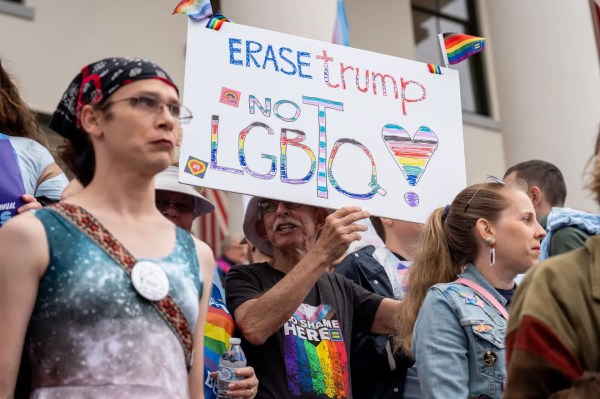
LGBTQ rights advocates from across Florida walked the streets of Tallahassee and met at the steps of the Historic Capitol Thursday to protest legislation that they say would further roll back their rights.
Wearing blue shirts that said “Let Us Live,” protesters chanted, “This is what democracy looks like,” in fierce wind and rain.
“We need to start running for office,” said Jules Rayne, a community organizer for Equality Florida and Manatee County resident. “We need to be everywhere, in every school district, in every county commissioner’s seat, in every mayor’s office.”
After years of the Florida Legislature passing bills that target the transgender community, the Republican-led branch of government still isn’t letting up. There are multiple bills attempting to further prohibit state funding for diversity, equity and inclusion in K-12 schools, state agencies and higher education.
Hundreds of Floridians marched from Cascades Park to the Capitol Thursday morning for the “Let Us Live March” to protest these bills and hold a rally on the front Capitol steps with trans leaders, who said they weren’t letting up, either.
LGBTQ advocates highlighted a small win that happened earlier this week, when two anti-DEI bills, “Gender Identity Employment Practices” (SB 440) and “Prohibited Preferences in Government Contracting” (SB 1694) were postponed in their committee on Tuesday.
SB 440, sponsored by Sen. Stan McClain, R-Ocala, and called the “Freedom of Conscience in the Workplace Act,” would prohibit employers from being required to use certain pronouns or requiring them to use a pronoun that does not correspond to the employee’s or contractor’s sex. Critics are calling it the “Don’t Say Gay or Trans at Work” bill.
And SB 1694, sponsored by Sen. Randy Fine, R-Melbourne Beach, would prohibit an awarding body from giving preference to a vendor on the basis of race or ethnicity.
More than 1,000 members of the public signed up to comment during the Senate Committee on Governmental Oversight and Accountability, which Sen. Carlos Guillermo Smith, R-Orlando, said attributed to the bills getting delayed. Smith said it’s evidence that “people power works.”
“All of this other stuff related to DEI is not solving any problems. It’s not improving anyone’s life, and it’s just honestly needlessly dividing us,” he said.
There are still other anti-DEI bills making their way through committees, however, including one that some say would push the controversy over book bans into overdrive and another that would potentially halt funds for efforts like domestic abuse shelters for women.
“Prohibitions and Limitations on Diversity, Equity, and Inclusion and Requirements for Medical Institutions of Higher Education” (SB 1710) was passed through the same committee that temporarily postponed SB 440 and SB 1674. That measure, sponsored by Sen. Nick DiCeglie, R-St. Petersburg, prohibits state agencies from expending certain funds for a DEI office or officer.
Another measure by McClain, the same sponsor as the so-called “Don’t Say Gay or Trans at Work” bill, would define the term “harmful to minors,” and further limit classroom materials. “Material that is Harmful to Minors,” (SB 1692), says: “The school board may not consider potential literary, artistic, political, or scientific value as a basis for retaining the material.” That bill passed through a Senate Criminal Justice Committee and is headed to the Committee on Education K-12.
If passed, work “by Shakespeare or other very well-known authors would be on the chopping block in our public schools, which brings us in the wrong direction all over again,” Smith said.
And most worrisome for Rayne, the Manatee County community organizer, is “Official Actions of Local Governments” (SB 420), which would prohibit counties and municipalities from funding, promoting or taking official action as it relates to DEI.
It would prohibit local governments from promoting or providing differential or preferential treatment or special benefits to a person or group based on that person’s or group’s race, color, sex, ethnicity, gender identity or sexual orientation.
Critics of the bill included some Republicans, who said the bill needed more work, especially with the word “differential” versus “preferential.”
“If we provide differential treatment to a person based on sex, that could create a problem with a program that was intended for abused women, which nobody would want to get rid of,” said Sen. Kathleen Passidomo, R-Naples. “We really need to hone in on where you’re trying to go.”
The bill still passed along party lines, with all Republicans voting yes.
Rayne said she believes this bill, along with many of the other anti-DEI measures, are broadly written, poorly defined and don’t serve the diverse, unique population of Florida.
“It’s going to put Floridians’ lives at risk and further erase our culture,” she said. “These bills are not what people are talking about at their kitchen table.
“Culture wars are not what Floridians care about.”
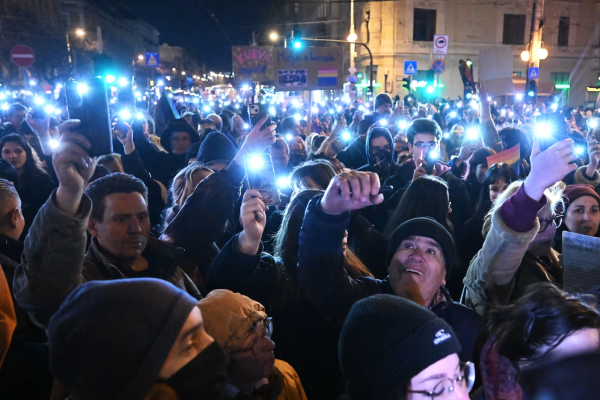
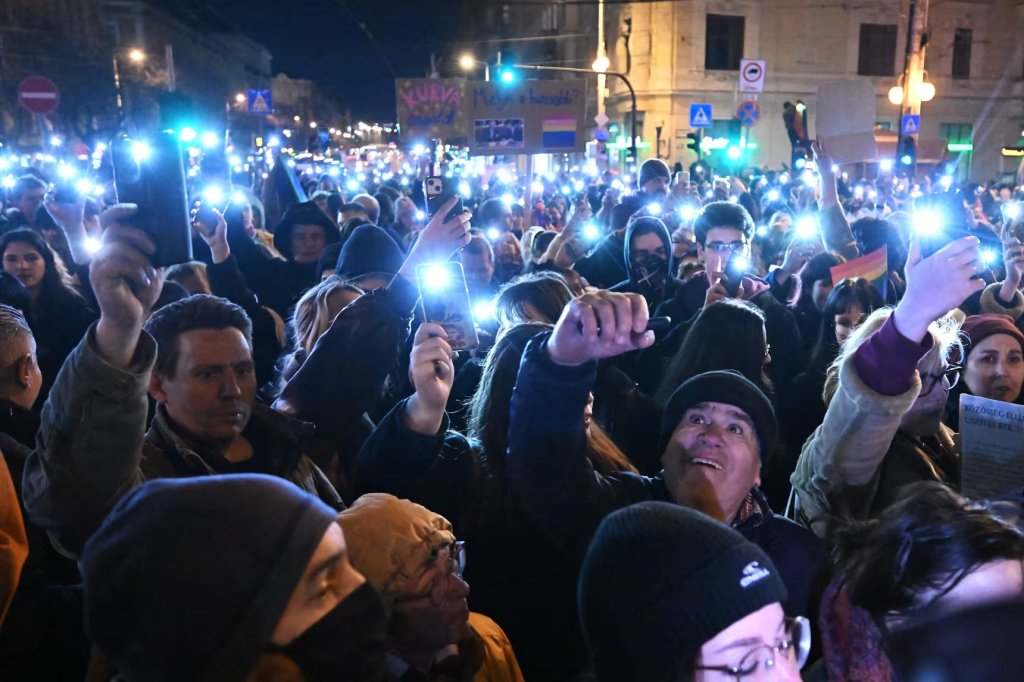
A new anti-LGBTQ law banning Pride events and allowing authorities to use facial recognition software to identify those attending the festivities was passed in Hungary on Tuesday, leading to a large demonstration on the streets of Budapest.
Several thousand protesters chanting anti-government slogans gathered after the vote outside Hungary’s parliament. They later staged a blockade of the Margaret Bridge over the Danube, blocking traffic and disregarding police instructions to leave the area.
The measure, which is reminiscent of similar restrictions against sexual minorities in Russia, was passed in a 136-27 vote. The law, supported by Orbán’s Fidesz party and their minority coalition partner the Christian Democrats, was pushed through parliament in an accelerated procedure after being submitted on Monday.
Opposing legislators led a vivid protest in the legislature involving rainbow-colored smoke bombs.
At the protest outside parliament, Evgeny Belyakov, a Russian citizen who immigrated to Hungary after facing repression in Russia, said the legislation went at the heart of people’s rights to peacefully assemble.
“It’s quite terrifying to be honest, because we had the same in Russia. It was building up step by step, and I feel like this is what is going on here,” he said. “I just only hope that there will be more resistance like this in Hungary, because in Russia we didn’t resist on time and now it’s too late.”
The bill amends Hungary’s law on assembly to make it an offense to hold or attend events that violate Hungary’s contentious “child protection” legislation, which prohibits the “depiction or promotion” of homosexuality to minors under 18.
Attending a prohibited event will carry fines up to 200,000 Hungarian forints ($546), which the state must forward to “child protection,” according to the text of the law. Authorities may use facial recognition tools to identify individuals attending a prohibited event.
In a statement on Monday after lawmakers first submitted the bill, Budapest Pride organizers said the aim of the law was to “scapegoat” the LGBTQ+ community in order to silence voices critical of Orbán’s government.
“This is not child protection, this is fascism,” wrote the organizers of the event, which attracts thousands each year and celebrates the history of the LGBTQ+ movement while asserting the equal rights of the gay, lesbian, bisexual and transgender community.
Following the law’s passage Tuesday, Budapest Pride spokesperson Jojó Majercsik told The Associated Press that despite Orbán’s yearslong effort to stigmatize LGBTQ+ people, the organization had received an outpouring of support since the Hungarian leader hinted in February that his government would take steps to ban the event.
“Many, many people have been mobilized,” Majercsik said. “It’s a new thing, compared to the attacks of the last years, that we’ve received many messages and comments from people saying, ‘Until now I haven’t gone to Pride, I didn’t care about it, but this year I’ll be there and I’ll bring my family.’”
Government crackdown
The new legislation is the latest step against LGBTQ+ people taken by Orbán, whose government has passed other laws that rights groups and other European politicians have decried as repressive against sexual minorities.
In 2022, the European Union’s executive commission filed a case with the E.U.’s highest court against Hungary’s 2021 child protection law. The European Commission argued that the law “discriminates against people on the basis of their sexual orientation and gender identity.”
Hungary’s “child protection” law — aside from banning the “depiction or promotion” of homosexuality in content available to minors, including in television, films, advertisements and literature — also prohibits the mention of LGBTQ+ issues in school education programs, and forbids the public depiction of “gender deviating from sex at birth.”
Booksellers in Hungary have faced hefty fines for failing to wrap books that contain LGBTQ+ themes in closed packaging. Critics have argued Orbán’s campaign amounts to an attempt to cut LGBTQ+ visibility, and that by tying it to child protection, it falsely conflates homosexuality with pedophilia.
Hungary’s government argues that its policies are designed to protect children from “sexual propaganda.”
Is Orbán trying to distract the electorate?
Hungary’s methods resemble tactics by Putin, who in December 2022 expanded Russia’s ban on “propaganda of nontraditional sexual relations” from minors to adults, effectively outlawing any public endorsement of LGBTQ+ activities.
Orbán, in power since 2010, faces an unprecedented challenge from a rising opposition party as Hungary’s economy struggles to emerge from an inflation and cost of living crisis and an election approaches in 2026.
Tamás Dombos, a project coordinator at Hungarian LGBTQ+ rights group Háttér Society, said that Orbán’s assault on minorities was a tactic to distract voters from more important issues facing the country. He said allowing the use of facial recognition software at prohibited demonstrations could be used against other protests the government chooses to deem unlawful.
“It’s a very common strategy of authoritarian governments not to talk about the real issues that people are affected by: the inflation, the economy, the terrible condition of education and health care,” Dombos said.
Orbán, he continued, “has been here with us for 15 years lying into people’s faces, letting the country rot basically, and then coming up with these hate campaigns.”









You must be logged in to post a comment.