With increasing attacks on LGBTQ+ rights over the past few years, it is no surprise that LGBTQ+ adults are struggling with their mental health. A new study from the Human Rights Campaign (HRC) Foundation details how these struggles can adversely affect state economies and serves to remind lawmakers that when LGBTQ+ people suffer, the country follows.
In the HRC Foundation’s 2024 LGBTQ+ Climate Survey, 71.5% of adults reported that anti-LGBTQ+ legislation has negatively impacted their health or well-being in the past year.
44.3% of LGBTQ+ adults and 63.5% of trans adults also said anti-LGBTQ+ legislation has harmed their mental health or the mental health of their loved ones, and 66.1% of LGBTQ+ adults, along with 83.4% of trans adults, said anti-LGBTQ+ legislation has made them feel less safe.
The report found that as a result of these fears, one in five LGBTQ+ adults are considering moving to a new state and one in 20 are trying to change jobs. Half of LGBTQ+ adults said anti-LGBTQ+ legislation has already impacted their choices of where to live and work in the last year, and one in five said they’ve refused a job or home in states with anti-LGBTQ+ legislation. 4% say they have already left their state or have taken steps to leave, and one in 20 are trying to change jobs due to anti-LGBTQ+ legislation.
“It is mentally exhausting to live in a state where the legislature and governor bully communities of color and LGBTQ+ communities,” said one cisgender lesbian woman who participated in the study. “It takes a toll. We will be moving from this state.”
A gender-questioning person from New York added, “I purposely turned down a dream job in a state where these laws were passed. Also, the laws affect my work, as I am a physician and cannot practice the full spectrum medicine I would like to.”
One cis queer woman stated that the laws “have radically impacted my queer & trans household” and that they are “actively shopping to relocate to MI or ME, leaving behind a business, a gorgeous home & property, a high-income career, and a non-profit we run in the queer community.”
Shoshana Goldberg, public education and research program director at the HRC Foundation, told The Advocate that this will no doubt hurt the economics of the states and businesses being abandoned.
“I think states stand to lose economically by continuing to support these laws. They risk losing the tourism and business travel dollars, such as those from the 30 percent of LGBTQ+ adults, in the last year alone, who have avoided, canceled, and/or refused to travel to states with anti-LGBTQ+ legislation,” she says. “They risk losing the taxable income from LGBTQ+ adults, and families of LGBTQ+ youth, who are looking to move to a new state where they and their children can live openly and freely … and companies headquartered in these states risk losing customers.”
She added, “The LGBTQ+ Community holds $1.4 trillion in purchasing power, and unsupportive companies stand to lose us as customers — as well as lose allies, particularly Millennials and Gen Z, who data shows are looking to spend their money on those companies that support their values of equality.”
She also warned that companies who halt DEI practices risk not only losing customers but also top talent.
Jan 31 (Reuters) – The U.S. Centers for Disease Control and Prevention and other federal health agencies on Friday took down webpages with information on HIV statistics and other data to comply with Trump administration orders on gender identity and diversity, raising concerns among physicians and patient advocates.
CDC webpages that appear to have been removed include statistics on HIV,among transgender people and data on health disparities, among gay, lesbian, bisexual and transgender youth. A database tracking behaviors,that increase health risks for youth was offline.
The Office of Personnel Management gave agencies more specific guidance on how to comply with the orders in a Jan. 29 memo,saying they were to be completed by 5 p.m. ET (2200 GMT) on Jan. 31.
It specified that agencies must end all programs that promote or reflect “gender ideology extremism” by recognizing a self-determined gender identity rather than biological sex. The measures include removing references to gender identity online.
A spokesperson for the Health and Human Services Department, which oversees the CDC, said any changes to websites follow this guidance.
“There’s a lot of work going on at the agency to comply,” said a source who was not authorized to speak publicly, adding that the CDC is “taking down anything on the website that doesn’t support this executive order.”
Deletions from the CDC’s site include pages with data on HIV in the United States in general, as well as pages with statistics on HIV in Hispanic/Latino people, women, by age, and by race and ethnicity.
The elimination of such data “creates a dangerous gap in scientific information and data to monitor and respond to disease outbreaks,” the Infectious Diseases Society of America and the HIV Medicine Association said in a joint statement.
For example, a page with information about how people can get HIV tests was offline on Friday, according to the Internet Archive, as was a page for doctors with information about testing for HIV and treating patients.
“This is very alarming,” said John Peller, head of the AIDS Foundation Chicago. “In many cases, basic health information is going dark.”
Timothy Jackson, senior director of policy and advocacy at the group, said they are going through the CDC website and printing out information used to educate people about HIV that may not be accessible after Friday.
Also missing from the CDC’s website was the Youth Risk Behavior Surveillance System, which tracks trends in tobacco use, teen pregnancy, unsafe sexual behavior and other aspects of teen health.
At the National Institutes of Health, a senior employee this week urged agency leaders to refuse to implement the Trump administration’s guidance in an email to acting NIH Director Matthew Memoli and other top officials that was seen by Reuters.
The employee, Nate Brought, director of the NIH executive office, said Trump’s orders ran contrary to years of NIH research and findings about sexuality and gender.
“By complying with these orders, we will be denigrating the contributions made to the NIH mission by trans and intersex members of our staff, and the contributions of trans and intersex citizens to our society,” he wrote.
“These policies will lead to mental health crises or worse for tens of thousands of Americans who contribute productively to our communities.”
Reporting by Julie Steenhuysen in Chicago and Ted Hesson in Washington; Additional reporting by Jaimi Dowdell in Los Angeles and Brad Heath in Washington; Editing by Leslie Adler and Bill Berkrot.
President Trump on Tuesday signed a sweeping executive order meant to broadly restrict access to gender-affirming care for transgender children and teenagers younger than 19, inching closer to fulfilling a key campaign promise to ban treatments that he and his administration have cast as experimental and dangerous, in conflict with major medical associations and transgender health experts.
“Across the country today, medical professionals are maiming and sterilizing a growing number of impressionable children under the radical and false claim that adults can change a child’s sex through a series of irreversible medical interventions,” Tuesday’s order states. “This dangerous trend will be a stain on our Nation’s history, and it must end.”
“Accordingly, it is the policy of the United States that it will not fund, sponsor, promote, assist, or support the so-called ‘transition’ of a child from one sex to another, and it will rigorously enforce all laws that prohibit or limit these destructive and life-altering procedures,” the order states.
Every major medical organization supports gender-affirming care for transgender adults and minors, although not every trans person chooses to medically transition or has access to care.
Trump’s executive order, titled “Protecting Children from Chemical and Surgical Mutilation,” tasks federal agencies with rescinding or amending policies that rely on guidance from the World Professional Association for Transgender Health (WPATH), including the organization’s latest standards of care, released in 2022.
WPATH, a nonprofit professional organization devoted to transgender health care, did not immediately return a request for comment.
Trump’s order tasks the incoming Secretary of Health and Human Services (HHS) with publishing a review of existing literature on best practices “for promoting the health of children who assert gender dysphoria, rapid-onset gender dysphoria, or other identity-based confusion.”
Rapid-onset gender dysphoria, which claims that adolescents identify as transgender because of influence from friends or social media, is not recognized as a valid medical diagnosis by major professional medical organizations. In 2021, 61 professional health care organizations, including the American Psychological Association, signed a letter stating the condition lacks “rigorous empirical support for its existence.”
According to Tuesday’s order, heads of executive departments and agencies that provide research and education grants to medical institutions, including medical schools and hospitals, should take immediate steps to block funding for institutions that continue providing gender-affirming care to minors.
Meredithe McNamara, an assistant professor of pediatrics at Yale University specializing in adolescent medicine, said the provision amounts to “an immediate de facto ban on medical care” for trans youth who receive care at academic medical centers.
“It basically defunds those medical centers if they continue to provide that care,” McNamara said of the order.
“This is a stunning example of how all health care is tied together, and how the most effective way to attack gender-affirming care is to attack the entire health care apparatus as a whole,” she added in an interview. “They’re holding everyone hostage and saying, ‘We’re going to take away everyone’s healthcare unless you systematically deprive just these people.’”
Trump’s executive order additionally directs the HHS Secretary — a position he wants for Robert F. Kennedy, Jr. — to bar access to gender-affirming care for transgender minors through federal programs like Medicaid and Medicare and withdraw the department’s 2022 guidance supporting gender-affirming care. The secretary should issue new guidance, in consultation with the incoming attorney general, “protecting whistleblowers who take action related to ensuring compliance with this order,” according to Tuesday’s order.
The executive order also directs Defense Secretary Pete Hegseth to draft a rule to exclude coverage for gender-affirming care for minors from TRICARE, the military’s health program. Former President Biden in December signed a $895 billion defense policy bill barring TRICARE from covering transition-related care for transgender children of active-duty service members, a provision that military families with transgender kids called a “slap in the face.”
Tuesday’s order similarly tasks the director of the Office of Personnel Management with taking steps to remove coverage for gender-affirming care for trans youth from federal health plans.
It also asks the attorney general to prioritize enforcement of existing federal laws against female genital mutilation, which carry a penalty of up to 10 years in prison. The attorney general should also “prioritize investigations and take appropriate action to end deception of consumers, fraud, and violations of the Food, Drug, and Cosmetic Act” by entities that may be “misleading the public” about the long-term side effects of transition-related care.
Republican state attorneys general have, in recent years, used consumer protection laws to investigate individuals and organizations that provide gender-affirming care to minors. A Senate Finance Committee report released in April claimed that at least four GOP attorneys general — Ken Paxton of Texas, Todd Rokita of Indiana, Jonathan Skrmetti of Tennessee and Andrew Bailey of Missouri — abused their oversight authorities to “further ideological and political goals.”
Trump’s executive order additionally directs the attorney general to work with Congress to “draft, propose, and promote legislation” to enact a private right of action for children, as well as their parents, “whose healthy body parts have been damaged” by medical professionals practicing transgender health care.
The attorney general should also take “appropriate action,” the order states, “to end child-abusive practices by so-called sanctuary States,” including through the potential application of the Parental Kidnapping Prevention Act, a federal law preventing one parent from interfering with another parent’s custody rights.
Conservative organizations celebrated Trump’s executive order Tuesday evening. In a joint statement, Independent Women’s Forum and Independent Women’s Voice said the move restores the “true meaning of ‘care’ for America’s youngest generation.”
Kristina Rasmussen, executive director of Do No Harm, a health policy group that opposes gender-affirming care for minors, said Trump’s order prioritizes “safety, scientific integrity, and family autonomy.”
Omar Gonzalez-Pagan, senior counsel and health care strategist at the LGBTQ civil rights organization Lambda Legal, called the order “morally reprehensible and patently unlawful” and said the group would sue.
“The federal government — particularly, this administration — has no right to insert itself into conversations and decision-making that rightly belongs only to parents, their adolescent children, and their medical providers,” he said.
The executive order comes after Trump signed separate orders declaring that the federal government recognizes only two sexes, male and female, and barring transgender people from serving openly in the military.
LGBTQ activists in New Jersey say they’re fortunate to live in New Jersey as the new administration kicks-off its term by attacking the transgender community and diversity initiatives. Advocates at Garden State Equality say New Jersey sets a standard for legal equality that can inspire states throughout the country.
As part of its education and advocacy “Going Local” programming across the country, the GLAAD Media Institute (GMI) – GLAAD’s training, research and consulting division – convened meetings with local leaders and community advocates at Garden State Equality and throughout the nation. Attendees who complete a program or session with the GLAAD Media Institute are immediately deemed GLAAD Media Institute Alumni, who are equipped to maximize community impact by leveraging their own story for culture change.
The state is known for its tough pro-equality laws like New Jersey Law Against Discrimination (LAD), which is considered one of the most comprehensive anti-discrimination laws in the country. Yet, new laws in the state legislature help combat a rise of LGBTQ disinformation and hate speech, straight out of Project 2025. The anti-LGBTQ hate machine has affected dozens of Jersey school board’s policies on book bans, critical race theory, and sex education.
Since Garden State Equality’s founding in 2004, over “230 LGBTQ civil rights laws” have been enacted at the state, county, and local levels. According to the organization’s website, that’s “more laws in less time than in any other state in American history.”
On a federal level, President Trump began his second term signing executive orders to dispute the fact that transgender and gender diverse people exist. On Trump’s first days in office he signed an executive order titled Defending Women From Gender Ideology Extremism and Restoring Biological Truth to the Federal Government. The order is used to delegitimize trans truth, history, and science, which promptly raised concerns over a federal ban of the “x” gender marker for people of nonbinary, trans or gender nonconforming experience in the United States.
“As of today, it will henceforth be the official policy of the United States government that there are only two genders, male and female,” President Trump incorrectly said upon signing the order.
Garden State Equality says they’re ready to resist these efforts by the current administration, and continue to encourage diversity, equity, and inclusion (DEI) programs, while uplifting best practices for LGBTQ youth and adult community members as they have within their state government, says advocates.
“We want our youth to understand that they don’t just live in a bubble here in New Jersey, that the work that they are doing to be activists here in our state is going to influence other states and other students across the nation,” Natalie Hernandez told GLAAD.
Natalie Hernandez, camp director and project manager & trainer; Screenshot by Lana Leonard
Hernandez is the Camp Director of Garden State Equality’s Changemakers Youth Leadership summer program. Empowering youth leaders helps inform the work of other departments and so forth, it’s a collaborative effort to fight for legal equality for the state organization.
Hime Sarah Thomas, project manager and trainer with the Education and Youth Development Department, grew up in a queer family who introduced Thomas to Garden State Equality through the Changemakers Youth Leadership summer program. Thomas works to encourage youth to become “changemakers” by giving them an outlet to express their frustrations, and amplify their voices.
Only a small number of youth actually transition: less than one-tenth of one percent of teenagers with private insurance in the United States are transgender and receive gender-related medicine, according to a study by JAMA Pediatrics.
“These youth need a space where they can talk about all the things that are happening in the news and the world because they don’t have the autonomy to be able to vote and make those choices on who is representing them,” Thomas said.
For Aisling MacDonald, a project manager for the organization’s Training and Trans Resiliency Program, which advocates for the wellness of transgender and gender nonconforming adults and families moving into New Jersey for their LGBTQ protections.
“Our world is ever evolving. There are some very legitimate anxieties, and also… we are really, really fortunate to live here,” MacDonald said.
MacDonald spends much of her day building coalition relationships and legal resources for name changes and documents for trans people who have been under attack on social media, through legislation, and the news.
Hime Sarah Thomas, project manager & trainer; Screenshot by Lana Leonard
“My experience as a woman of trans experience who is from some very particular demographics, and a very particular flavor of multiple marginalizations, is that we do not have a lot of trust for systems, institutions and legislators, especially,” MacDonald said. “And I think more than anything else in 2025 we have an opportunity to build a different kind of community.”
These insights into the LGBTQ community of Asbury Park lead into a larger narrative about community needs in New Jersey and beyond. Even still, Garden State Equality recognizes that there are hurdles that must still be overcome.
More about the GLAAD Media Institute: The GLAAD Media Institute provides training, consultation, and actionable research to develop an army of social justice ambassadors for all marginalized communities to champion acceptance and amplify media impact. Using the best practices, tools, and techniques we’ve perfected over the past 30 years, the GLAAD Media Institute turns education into armor for today’s culture war—transforming individuals into compelling storytellers, media-savvy navigators, and mighty ambassadors whose voices break through the noise and incite real change. Activate with the GLAAD Media Institute now at glaad.org/institute
More than a quarter million LGBTQ+ young people and family members in the U.S. have relocated to other states because of LGBTQ+-related politics or laws, according to estimates outlined in a new report exploring the population’s response to hostile policy environments.
According to the brief compiled by The Trevor Project and Movement Advancement Project, 9 in 10 LGBTQ+ young people say politics have impacted their well-being, while 4 in 10 say they’ve thought about moving to another state because of unfriendly LGBTQ+ politics or laws at home.
The portion was even higher for transgender and nonbinary youth, 94% of whom said politics had affected their well-being and nearly half (45%) who said they’d considered relocating.
“For many LGBTQ+ young people in the U.S., the steady stream of anti-LGBTQ+ news may feel overwhelming right now,” said Steven Hobaica, a research scientist for the Trevor Project, a national LGBTQ+ youth advocacy group focused on suicide prevention. “It’s heartbreaking to see that nearly half of transgender and nonbinary youth have considered moving due to anti-LGBTQ+ policies.”
While just 4% of LGBTQ+ young people ages 13 to 24 reported uprooting because of anti-LGBTQ+ policies, that translates to roughly 266,000 young people and family members based on LGBTQ+ youth population estimates, the groups said.
Trump administration presents new threats
The report comes as President Donald Trump returns to the White House after making gender identity issues a focal point of his campaign. On Monday, after being sworn in, Trump issued a spate of executive orders that included seeking to remove legal protections for transgender people in federal spaces, laying the groundwork to potentially bar transgender individuals from military service and declaring that the U.S. government will only recognize two sexes, male and female.
“No matter a person’s political beliefs, we know, from our research and from what LGBTQ+ young people tell us, that policies like these take a damaging toll on LGBTQ+ young people’s mental health,” said Janson Wu, The Trevor Project’s senior director of state advocacy and government affairs.
The organization said its crisis services saw a 33% increase on Inauguration Day compared to typical volume. But that still paled, it noted, to the sevenfold increase in crisis services experienced the day after the 2024 election.
“No matter your political beliefs or how you feel about the current administration, one thing must be made clear to all of us living in the United States: Real young people’s lives are at risk,” said Trevor Project CEO Jaymes Black.
Recent years have already seen increasing numbers of state laws and proposed legislation targeting the LGBTQ+ community, especially measures aimed at curbing the rights of transgender youth.
“It’s critical that we not only call attention to the negative impact of these divisive political attacks but also highlight that this research supports the idea that more inclusive policy environments lead to better outcomes for LGBTQ young people across a range of measures,” said Logan Casey, director of policy research for Movement Advancement Project.
Hostile climates raise mental, emotional health risk
The organizations said they compiled the report given a lack of research into how LGBTQ+ young people respond to hostile policy environments, despite studies showing that those youths experience greater mental health challenges and higher suicide risk in such environments.
“By gaining more knowledge of how LGBTQ+ young people respond to their policy environment, advocates and policymakers can create or modify policy to better support LGBTQ+ young people and their families,” the report said.
Their joint report is based on data gleaned from The Trevor Project’s 2024 U.S. National Survey on the Mental Health of LGBTQ+ Young People, which collected responses from more than 18,600 LGBTQ+ individuals between the ages of 13 and 24. It also incorporates data from Movement Advancement Project, a Boulder, Colorado-based group that tracks LGBTQ+-related laws and policies throughout the U.S. and its territories and assigns each a negative or positive policy index.
More than a quarter (27%) of respondents lived in states with negative policy indexes, the report said. Those individuals were more likely than their counterparts to consider moving to other states and also likelier to travel to other states to receive health care.
The report noted that not all LGBTQ+ young people and their families desiring to relocate have the resources to do so.
“Notably, the same factors that might preclude the ability of LGBTQ+ young people and their families from moving, such as poverty, housing discrimination, and employment access, are the same ones that disproportionately affect LGBTQ+ people of color and increase their risk of mental health and suicide,” the report said.
The federal government is set to only recognize two sexes, male and female, under an executive order that President Donald Trump is soon expected to sign.
The order would reverse efforts by the Biden administration to broaden gender identity designations, including on passports.
“As of today, it will henceforth be the official policy of the United States government that there are only two genders, male and female,” Trump said during his inaugural address Monday, taking an early step to fulfill one of his culture war campaign promises.
The order, a Trump administration official told reporters Monday, is aimed at “defending women from gender ideology extremism and restoring biological truths to the federal government.” Male and female “are sexes that are not changeable, and they are grounded in fundamental and incontrovertible reality,” the official said.
The federal government would also shift from using the term “gender” to “sex,” and that sex would be “an individual’s immutable biological classification,” the official said.
All government agencies would ensure that official documents, including passports and visas, “reflect sex accurately,” the official said. Also, departments running federal prisons, migrant shelters, rape shelters and other “intimate spaces” would be directed to protect single-sex spaces for privacy. And employee records would also adhere to the executive order, as would federal departments’ messaging.
“Agencies are no longer going to promote gender ideology through communication forms and other messages,” the official said, adding that grants and contracts would be reviewed to ensure that “federal funds shall not be used to promote gender ideology.”
Reversing Biden expansion
Trump’s executive order would dismantle efforts by the Biden administration to be more inclusive of Americans’ gender identification.
As of 2022, US citizens have been able to select “X” as their gender marker on passports. One’s marker does not need to match the gender on citizenship documents or photo ID, nor is medical documentation needed to change one’s gender, according to the State Department.
“We promote the freedom, dignity, and equality of all people – including LGBTQI+ individuals,” the department’s website says. “We are demonstrating this commitment to better serve all U.S. citizens, regardless of gender identity.”
Later that year, Americans were able to start changing their sex identification with the Social Security Administration without needing to provide medical certification. However, Social Security’s record systems still require a designation of male or female, though the administration said it was exploring policy and systems updates to support an “X” designation.
“The Social Security Administration’s Equity Action Plan includes a commitment to decrease administrative burdens and ensure people who identify as gender diverse or transgender have options in the Social Security number card application process,” said Kilolo Kijakazi, the administration’s acting commissioner at the time.
Ohio Governor Approves Ban on Transgender Students Using Preferred Bathrooms
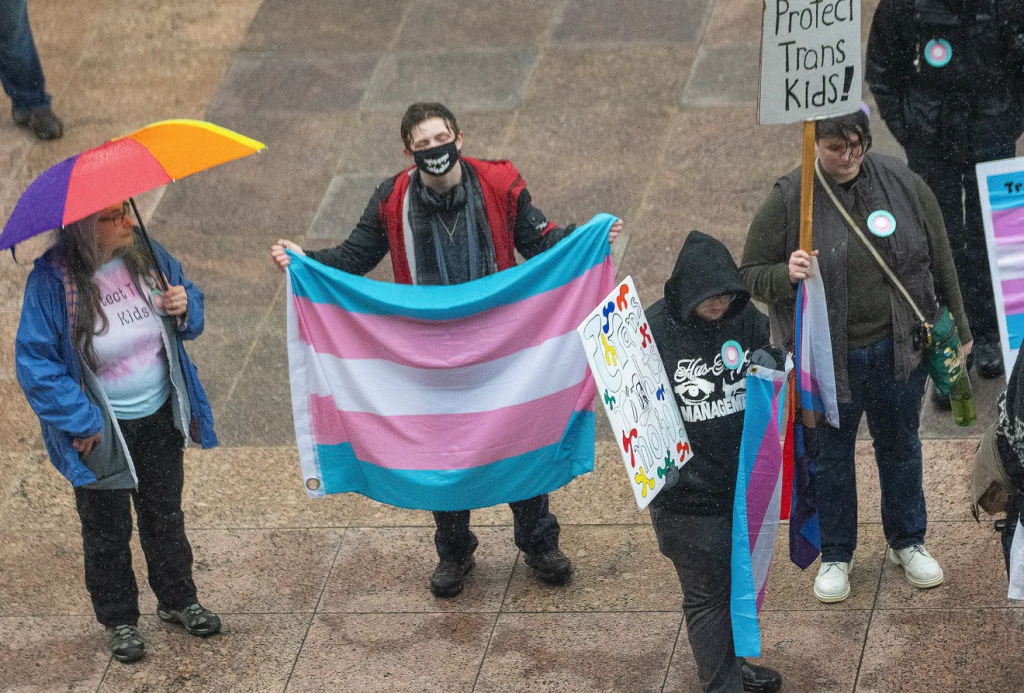
Texas Transgender Community Fights Back After Capitol Bathroom Ban
Residents of Odessa, Texas, are speaking out after the city council amended a local ordinance to ban transgender individuals from using public restrooms that align with their gender identity. Meanwhile, in Ohio, Republican Governor Mike DeWine has signed a law banning transgender students from using bathrooms that correspond to their gender identity. The new legislation mandates that students in K-12 schools, as well as colleges and universities, must use the restroom or facility designated for their sex assigned at birth.
The law clarifies that it does not prohibit schools from constructing single-occupancy restrooms and allows individuals of the opposite gender to enter a bathroom to assist someone else, if necessary.
MORE: Congressional Bathroom Ban Adds to Growing Transgender Policy Debate
Ohio now joins at least 14 other states in restricting transgender individuals from using bathrooms that match their gender identity, according to the Human Rights Campaign.
Supporters argue that the ban addresses concerns about student privacy and safety, while critics contend that it fuels baseless fears about transgender students and could put them at greater risk of discrimination or harm.
Governor DeWine’s office did not respond to ABC News’ request for comment prior to the bill’s signing. However, in the summer, he told reporters that he was reviewing the “specific language” of the legislation.
“I’m supportive of kids being able to use bathrooms that align with their gender assigned at birth for their protection, but I’ll need to review the specific language of the bill,” DeWine told reporters.
Transgender healthcare, bathroom access, sports participation, and other related issues have become central to the Republican legislative agenda across the country in recent years. This trend has led to a surge in anti-LGBTQ bills, with hundreds introduced during the 2024 legislative session alone, according to the American Civil Liberties Union.
DeWine has occasionally bucked the state’s Republican leadership on transgender matters. In December 2023, he vetoed a bill that would have banned gender-affirming care for transgender youth, including restrictions on puberty blockers, hormone therapy, and surgeries.
With Trump potentially returning to office, I’m concerned that more transgender people will be denied the right that had such a profound impact on my life.
When I learned on August 21st that the Texas Department of Public Safety had quietly revoked the ability to change your gender on driver’s licenses and birth certificates, I was stunned. Devastated. The already daunting process of officially changing one’s name and gender marker had just been taken away. Trans Texans are now stripped of a right that once allowed me to live with less fear. And as Donald Trump nears a potential return to office, many are fearful that trans Americans nationwide could face the same loss.
On a random Tuesday in December 2020, I made the decision to start hormone replacement therapy (HRT). By then, I had been using they/them pronouns for two years and had undergone top surgery eight months earlier. For years, I had thought about beginning HRT, hoping it would help me escape a life where people assumed I was a woman based solely on my appearance. That day, I finally felt ready to silence the voices in my head telling me I’d be letting others down by embracing who I truly was. I was ready to step out of the shadows—out of the expectations others placed on me—and into my own light. I went to an LGBTQ+ clinic, got a prescription for testosterone, and, in that moment, I felt like my life was finally beginning.
And then everything changed.
By April 2021, my voice had deepened, stubble began appearing on my face, and I no longer had a period—physical changes I embraced with open arms. Strangers began noticing too, and suddenly, I was being treated differently. The looks I once got as a perceived butch lesbian shifted to confused stares, discomfort, and sometimes, outright disdain.
‘Dropping off flowers for your wife?’ a receptionist at a gynecologist’s office asked me that same April. ‘Not quite,’ I replied with a nervous laugh. ‘I’m here for an appointment.’ As is customary, I handed over my ID. She glanced at it—name: [something I no longer go by], sex: F—then looked back at me, clearly unsure how to reconcile the mismatch. She called over a coworker, whispering about what to do in this ‘situation.’ I stared at my phone, trying to stay calm as the coworker muttered, ‘Just check her in.’ And she did. I sat down, feeling that familiar discomfort of my presence unsettling others.
Throughout that entire doctor’s appointment, I was treated as though my body was something entirely unique—as if I were the only person who had ever transitioned. In moments like these, I try to chalk it up to ignorance, reminding myself that 71% of Americans say they’ve never met a trans person. But at what point does ‘ignorance’ become too generous?
This same scenario unfolded at the club when bouncers checked my ID, when people hesitated to call me ‘sir’ or ‘ma’am’ as they guided me to a table at restaurants, or when customer service reps asked me twice as many security questions as they did for others. And every time I needed to use the bathroom, I had to make the decision: men’s or women’s? At best, I was made uncomfortable for a few seconds. At worst, I was subjected to slurs or threats of violence. In all those moments, I told myself, ‘It’s no big deal’—as though it were no big deal for my mere existence to constantly puzzle or disturb people. The very fact of my body made others treat me as if I were a problem. I came to expect discomfort every time I stepped outside my door.
Every time I grabbed my keys, phone, and wallet, I weighed the emotional and physical risks of venturing out into the world. This constant calculation is why some trans people delay medical care or feel disconnected from the world around them. It’s also why, after two years on HRT, I finally decided to change the name and gender marker on my ID. But this was not a decision I made lightly.
Until August, changing your name and gender marker in Texas cost $350 (plus lawyer fees, unless you could prove you couldn’t afford it). You also needed a doctor’s note stating that you were ‘receiving clinically appropriate treatment related to your gender identity.’ (The pathologizing of transness is its own burden.) Once you had those documents and filled out a ‘Petition to Change the Name and Sex/Gender Identifier of an Adult’ form, you had to appear before a county judge. That judge could deny your petition for any reason—or no reason at all. It was a request, not a guarantee. In Texas, trans people often seek advice from other trans folks about which counties to target, because not all judges are inclusive. Many travel from across the state to Austin, the third-queerest city in the U.S., in hopes of a more supportive judge. Even then, judges can demand more ‘proof’ than the law requires. In a state where anyone can change their last name after marriage with minimal hurdles, trans people are forced to jump through countless hoops just to have their gender recognized.
It took a month for me to get a letter from a doctor. Another month passed before I could find time to go to the courthouse, which was only open during regular work hours—a schedule that most people can’t easily accommodate. When I finally arrived at the Travis County office, I sat for two hours waiting to be helped. A county clerk, who had warmly greeted other patrons, glanced at my petition and abruptly told me, ‘If you aren’t finished with your papers, we can’t help you.’ Despite the cold reception, I was determined to get this done—to untangle the mess of living as a visibly trans person. I handed in my request, and six weeks later, I received an email with a PDF confirming that my petition had been approved.
Afterward, I spent months updating my name and gender marker on my driver’s license, social security card, passport, and a slew of other official documents. One might ask, ‘Why would anyone willingly sign up for such a cumbersome and clearly prejudiced process?’ The answer is simple: I needed it. My body not matching the letters on my ID had become a life-threatening issue. Without the change, I’d still be trapped in the daily hell of being put in emotional and physical danger. Not all trans people feel the need to change their name and gender marker, but for me, it was crucial. Because this option was available, I’ve been able to build a new life.
The difference between my life from April 2021 to September 2022—when I didn’t ‘look like a girl’ but still had a feminine name and sex on my ID—and now is like night and day. I can hand over my ID and no longer feel like I’m putting myself in harm’s way. It says ‘Kaybee,’ Sex: M (though that still doesn’t feel right, since Texas hasn’t offered an X gender marker yet). Now, when I pass over a piece of plastic, I no longer feel like I’m outing myself or offering my life up for judgment.
In the same month that Texas reversed the right to change your name and gender marker, Trump announced he would sign an executive order banning gender-affirming care for trans youth on his first day back in office. As if it isn’t enough that Governor Greg Abbott, Lieutenant Governor Dan Patrick, Texas Attorney General Ken Paxton, and a whole host of other Texas politicians have pushed so much misinformation about the trans community that people now feel emboldened to mistreat us. As if it’s not enough that Texas attempts to pass transphobic laws every year.
Everything about this group of people—who could never understand what it’s like to hand over an ID that doesn’t match how the world sees you—fills me with disgust. They don’t know even a fraction of what people like me go through, just to live authentically.
Yes, I still have to explain to medical providers that my legal sex and my sex assigned at birth are not the same. Yes, I still out myself every time I take off my shirt, revealing the two beautiful top surgery scars that are part of my journey. My goal was never to ‘pass’ as cis, or to meet the ridiculous expectations that transphobes project onto us. My goal has always been to be myself. Safely.
Trump’s inauguration is on January 20th, and the next Texas legislative session—the period when most anti-trans laws will be debated—starts just a week earlier, on January 14th. In preparation, Texas lawmakers have already prefiled 34 anti-trans bills for the 2025 session. Now is the time to act, to support and defend the psychological and physical safety of trans people. I will be contributing both money and volunteer hours to the Transgender Education Network of Texas. This BIPOC-led organization fights anti-LGBTQ+ laws daily, and they offer a wealth of resources on their website, including guidance on how to file discrimination complaints with the U.S. Department of Health and Human Services.
Despite the wishes of those who seek to erase us, trans people like me will be part of the future of Texas—and beyond.
I long for a Texas where trans people don’t just survive, but thrive. We deserve safety here, in the Lone Star State, and anywhere else we choose to be. I spent too much time living under an identity that wasn’t mine, but I was able to change it. Everyone else deserves the same right to do so.
LGBTQ+ ballot initiatives have long served as a wedge issue, mobilizing conservative voters and influencing the rights and freedoms typically protected by law. The 2024 election follows this tradition, with LGBTQ+ civil rights once again being subjected to public debate.
In New York, voters will decide whether to include sexual orientation, gender identity, and gender expression in the state’s anti-discrimination amendment. Meanwhile, reproductive rights will also be up for a vote in 10 other states.
California, Colorado, and Hawaii voters will decide this November whether to repeal their states’ constitutional bans on same-sex marriage.
Since 1998, same-sex unions have consistently been the top issue on state referendums. In that time, 34 states have put the question to voters, with many passing constitutional amendments that prohibited same-sex marriage. These amendments were often used as a political tool to mobilize conservative voters, particularly in the 2004 election when 11 states approved such bans, helping to boost George W. Bush’s campaign.
Marriage equality consistently lost at the ballot box until 2012, when voters in Maine, Maryland, Minnesota, and Washington approved same-sex marriage, signaling a shift in public opinion that had been building since around 2009, when support for same-sex marriage crossed the 50% threshold in national polls.
In 2015, the Supreme Court’s landmark Obergefell v. Hodges decision struck down all state constitutional amendments banning same-sex marriage, declaring such bans unconstitutional. However, these amendments remain in place in several state constitutions. Activists are now pushing to repeal them, especially in light of concerns that the conservative-leaning Supreme Court could overturn Obergefell, as Justice Clarence Thomas hinted after the court struck down Roe v. Wade.
The Origins of Ballot Initiatives on LGBTQ+ Rights
California’s 1978 election introduced the first state ballot initiative related to LGBTQ+ rights—Proposition 6, also known as the Briggs Initiative. Sponsored by Orange County legislator John Briggs, the initiative sought to ban anyone who engaged in “public homosexual activity” from working in California public schools. The proposal was part of a broader wave of anti-gay activism spurred by Anita Bryant’s 1977 “Save Our Children” campaign in Florida, which successfully repealed Dade County’s anti-discrimination ordinance based on sexual orientation. Harvey Milk played a pivotal role in organizing the opposition to Prop 6, which was defeated by a 16-point margin.
Since then, other states have introduced ballot initiatives aimed at legalizing or banning discrimination based on sexual orientation or gender identity. Over time, voters have increasingly supported anti-discrimination measures. In 1988, Oregon voters overturned the governor’s authority to ban discrimination based on sexual orientation. In 2018, Massachusetts voters upheld a law prohibiting discrimination based on gender identity.
Maine and Oregon: Key States in the Fight for LGBTQ+ Rights
Maine and Oregon have consistently put LGBTQ+ rights to a vote. In Maine, voters initially blocked same-sex marriage in 2009, but then approved it by the same 53% margin in 2012. Maine also rejected anti-LGBTQ+ discrimination protections in 1998 and 2000, only to approve them in 2005. In Oregon, voters defeated a “don’t say gay” measure in 2000 by a narrow 5.7% margin.
Many states also used ballot measures to resist the inclusion of sexual orientation as a protected identity in anti-discrimination laws. In the 1990s, voters in Oregon, Idaho, and Maine approved such measures, protecting sexual orientation as a legally recognized identity.
The Impact of Other Ballot Measures on LGBTQ+ Rights
It’s not just LGBTQ+-specific ballot measures that impact the community. Other laws, such as voter ID requirements in Arkansas and North Carolina, disproportionately affect trans individuals and other marginalized LGBTQ+ people, limiting their ability to vote.
In addition to these referendums, the candidates voters elect at the state level will play a critical role in shaping LGBTQ+ rights. Republican-led legislatures have introduced or passed hundreds of bills targeting LGBTQ+ individuals, particularly in areas such as gender-affirming health care, bathroom access, inclusive education, and sports participation. Supporting state-level and local candidates who champion LGBTQ+ rights will have long-term implications, even if certain issues are not directly decided by referendum.
Civil Rights and Public Opinion
The fight for civil rights has a long history of being put to public referendum. Since 1868, issues related to race, sex, and disability have often been decided by voters, with initial support for discrimination gradually giving way to support for equality. While women’s rights gained public approval in the 1970s, LGBTQ+ rights did not see widespread support until the 2000s.
The question of whether civil rights should be determined by public opinion, rather than by courts or legislatures, has allowed forms of discrimination—such as racism, sexism, and homophobia—to become entrenched in law. Although public opinion on LGBTQ+ rights is often divided and fluid, most polls now show a majority in favor of anti-discrimination laws for LGBTQ+ individuals.
The Importance of Voting
With LGBTQ+ rights on the ballot this November, it’s more crucial than ever to vote. In addition to ballot measures, the elected officials who hold office at the state and local levels will have the power to pass or block pro-equality legislation, impacting LGBTQ+ rights for years to come. Whether through referendums or legislative action, LGBTQ+ rights remain at stake, and your vote matters.
Make your voice heard—not just on ballot measures, but by choosing candidates who will protect and advance equality for all.
A recent mailer from the Texas GOP is facing backlash for misrepresenting the story of a trans man and former high school wrestler, Mack Beggs.
The mailer targets Rep. Colin Allred (D-TX), who is challenging Ted Cruz (R-TX) for his Senate seat. It features a blurred image of Beggs when he was an out trans boy competing in girls’ sports, with the text: “Colin Allred failed to protect women’s sports, supporting boys competing with girls.”
At the time, the Texas University Interscholastic League (UIL), which governs public school sports, had prohibited Beggs from joining boys’ teams due to the gender marker on his birth certificate. While transitioning and taking testosterone, Beggs wrestled on the girls’ teams, becoming the center of controversy, particularly after winning state championships in 2017 and 2018.
Rep. Allred has consistently supported trans inclusion in sports, voting against bills that would have barred trans women from participating in women’s sports.
Beggs, now speaking out, expressed concern for his and his family’s safety due to the mailer’s misleading use of his image. “How they’re using my photo, it’s just very misleading. It’s not OK,” he told the Houston Chronicle. He is now seeking legal advice from the American Civil Liberties Union.
On Instagram, Beggs condemned the Texas GOP’s use of his story. “The Republican State of Texas Government has decided to USE my image for yet again one of their political campaigns,” he wrote. “I have already had a few people let me know about this campaign ad paid for and by the Republican Party in TX. NOT COOL. 🚫”
He added: “The fact they are STILL using my story and FACE for their political agendas. It’s sickening at this point.”
You must be logged in to post a comment.