
This blog originally appeared at VOX.
For the third instance in the past year, the Supreme Court declined a chance to significantly worsen the situation for transgender youth.
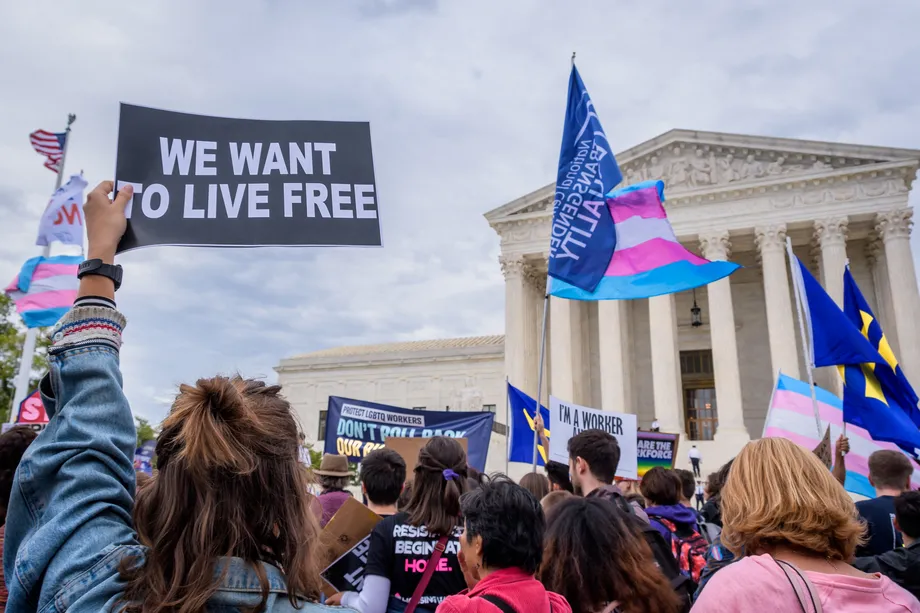
Protesters advocating for transgender rights outside the Supreme Court building in 2019.
For the third occasion in the past year, the Supreme Court surprisingly declined a case seeking to curtail the rights of young transgender individuals in a significant portion of the country.
On Tuesday, the Court declared its decision not to consider Metropolitan School District v. A.C., a case questioning whether public school districts can mandate transgender students to use bathrooms corresponding to their assigned birth sex rather than their gender identity.
In the A.C. case, the United States Court of Appeals for the Seventh Circuit sided with three transgender students, allowing them to use bathrooms that align with their gender identity. With the Supreme Court opting not to review this case, the Seventh Circuit’s decision will remain in effect, at least for the time being. The Seventh Circuit holds authority over federal legal matters in Illinois, Indiana, and Wisconsin.
Despite meeting the usual criteria the justices typically use to determine which cases to consider, the Court declined to take up this case. Notably, the issue of whether transgender students have the right to use bathrooms aligning with their gender identity has generated division among federal appeals courts, prompting the Supreme Court to often intervene and address such conflicts.
The opposition to transgender rights was also advocated by Republican attorney Paul Clement, a highly influential figure with considerable sway over the conservative wing of the Court, who previously served as the US Solicitor General.
A.C. marks the second occasion in slightly over a month where the Court has abstained from a significant LGBTQ rights dispute causing discord among lower court judges. In December, the Court similarly declared that it would not review Tingley v. Ferguson, a case challenging Washington state’s limitations on “conversion therapy” — a practice attempting to convert LGBTQ individuals into cisgender heterosexuals or hinder them from expressing their authentic sexual orientation or gender identity.
The lower court, which affirmed Washington’s restrictions, emphasized in its opinion that “every significant medical, psychiatric, psychological, and professional mental health organization opposes the utilization of conversion therapy.
Furthermore, in April of the previous year, in a case known as West Virginia v. B.P.J., the Court chose not to remove a transgender student from her middle school girl’s cross-country team. A lower court had halted a West Virginia state law preventing her from competing with other girls, and the Supreme Court declined a petition to temporarily reinstate that law during the ongoing litigation. (There remains a possibility that this case may return to the justices in the future.)
These rulings are unexpected for three main reasons. First, Republican appointees hold six out of the nine seats on the Supreme Court, and this Court has typically been highly receptive to concerns raised by the religious right. As recently as last June, the Court decided that a conservative Christian website designer possesses a constitutional right to discriminate against LGBTQ customers.
Moreover, both A.C. and Tingley met the standard criteria that justices typically employ to decide which cases to consider. In each instance, lower courts were in disagreement regarding the interpretation of federal law concerning LGBTQ rights.
Furthermore, in all three cases, the anti-LGBTQ side presented a plausible argument asserting that current law aligns with their desired result. The Tingley case hinges on conflicting language in a 2018 Supreme Court decision, which could be interpreted to endorse either outcome in Tingley. Meanwhile, the A.C. and B.P.J. cases pose questions that the Court left unresolved in its pivotal LGBTQ rights decision in Bostock v. Clayton County (2020).
In essence, it seems that, for the time being, the Court is avoiding cases related to transgender rights.
Cases involving transgender rights related to bathrooms and sports pose particularly intricate questions under the existing legal framework.
In the case of Bostock, the question revolved around whether a federal law prohibiting workplace discrimination based on “sex” also encompasses discrimination against LGBTQ individuals. Six justices determined that it does, and the Court affirmed that “it is impossible to discriminate against a person for being homosexual or transgender without discriminating against that individual based on sex.” For instance, if an employer dismisses a male employee for dating a man while allowing female employees to date men, it constitutes ordinary sex discrimination, as the employer permits women to engage in an activity not allowed for men.
Likewise, Bostock established that if an employer punishes an “employee who was identified as female at birth” for presenting as a man or participating in stereotypically male behavior, while not penalizing “a person identified as male at birth” for the same actions, it constitutes sex discrimination prohibited by federal law.
Although this marked a historic triumph for transgender rights, it also left unanswered one of the crucial questions in such cases: whether the legal concept of “gender” is distinct from the “status as either male or female [as] determined by reproductive biology.” Bostock, indeed, was decided under the assumption that the term “sex” exclusively pertains to “biological distinctions between male and female.”
Nevertheless, even under the assumption that the law pertains solely to “biological” sex, Bostock still determined that most forms of discrimination against transgender individuals contravene that law. This is because such discrimination inherently involves treating men (or individuals assigned male at birth) differently from women (or individuals assigned female at birth).
Federal law, nevertheless, allows for sex discrimination in specific restricted situations. For instance, the law prohibiting sex discrimination in most educational institutions permits these institutions to have “separate living facilities for the different
Likewise, longstanding interpretations of federal prohibitions against sex discrimination acknowledge the allowance of sex-segregated sports teams, as otherwise, women-only teams would not be viable.
Cases such as A.C. and B.P.J., in essence, pose a question that Bostock did not conclusively address. Bostock did not take a definitive stance on whether a transgender man is considered a man. In contrast, the Seventh Circuit had to determine, in deciding the A.C. case, “who counts as a ‘boy’ for the boys’ rooms, and who counts as a ‘girl’ for the girls’ rooms.”
If you seek a more in-depth examination of the legal arguments supporting and opposing the obligation for schools to treat transgender girls and boys equivalently to their cisgender counterparts, I delved into those arguments in greater detail in this piece. Presently, it’s worth noting that the Supreme Court seems resolute in avoiding a definitive resolution to this question, despite the ongoing divergence of opinions in lower courts on how it should be addressed.
 fleeredstates.blog
You must be logged in to post a comment.