
This blog is originally appeared at Advocate.
On May 17, the National Park Service (NPS) made an official ruling that park rangers and other employees are no longer allowed to attend Pride events and parades in uniform. This marks a reversal of a long-standing tradition of NPS participation in Pride parades across the U.S., including the presence of official delegations. Anonymous LGBTQ+ NPS employees have expressed feelings of betrayal, noting that participation in major city Pride events is now in question, as several parade applications remain unprocessed and approvals are unclear. The decision comes at a time of heightened scrutiny on LGBTQ+ issues nationwide, with increasing crackdowns on Pride flags and LGBTQ+ rights—largely driven by Republican lawmakers and appointees. This time, however, the policy change is being driven by the NPS itself, under the leadership of a director appointed by President Biden.
The new directive was first shared in an internal memo to NPS staff, which did not specifically mention Pride but highlighted that “requests from employees asking to participate in uniform in a variety of events and activities, including events not organized by the NPS,” are in conflict with agency policy. The memo cited a policy stating that NPS employees cannot wear their uniforms to events that might be interpreted as supporting “a particular issue, position, or political party.” LGBTQ+ employees, however, have criticized this application of the policy, arguing that Pride is about identity and diversity, not a political stance or issue. They pointed out that under the previous guidelines, NPS employees were able to participate in Pride events with approval, and that internal Employee Resource Group (ERG) documents, such as the “OUTsiders Guide to Pride,” had endorsed such participation for years.
In a follow-up statement, the NPS argued that the ERG guide conflicts with official policy and that discussions are underway to review it and other related documents. The agency also emphasized that its participation in Pride celebrations could be perceived as an endorsement of a particular “issue of public concern,” which they described as a justification for limiting official participation. In their view, what has long been seen as a celebration of diversity and inclusion is now categorized as a political statement, with the NPS deeming official participation in such events “extremely limited.”
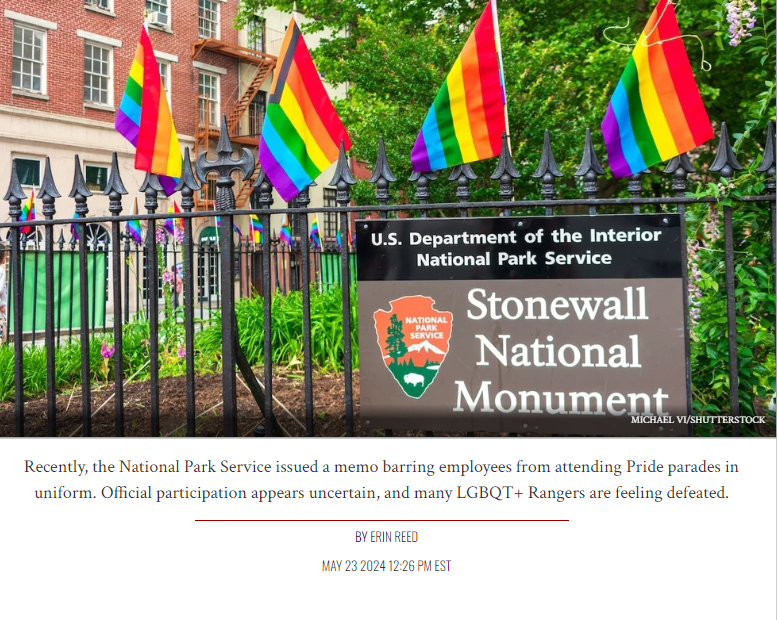
The decision sparked immediate concern among National Park Service employees and LGBTQ+ advocates. Many pointed out that the NPS has a long history of participating in Pride parades across the country, even under the Trump administration, which was known for its efforts to restrict LGBTQ+ representation in federal agencies, including at embassies. Employees also highlighted the significant role the NPS plays in managing Stonewall National Monument, a site dedicated to LGBTQ+ history and civil rights. Notably, the founding documents of Stonewall National Monument explicitly state that its purpose is “to preserve and protect Christopher Park and the historic resources associated with it” and “to interpret the Stonewall National Historic Landmark’s resources and values related to the lesbian, gay, bisexual, and transgender civil rights movement.” This has raised questions about how the NPS can reconcile this mission with its new stance on Pride participation.
One NPS employee, speaking anonymously, revealed that several requests for Pride parade participation are currently “collecting dust” on desks, waiting for approval for representation in major city Pride events. When asked about the decision to categorize Pride festivals as an “issue of public concern,” the employee responded, “Pride is not political, it’s not a cause, you just are LGBTQ+. It’s a celebration of who we are.” They added, “Morale is just so low right now. There’s not a lot of fight left in us.”
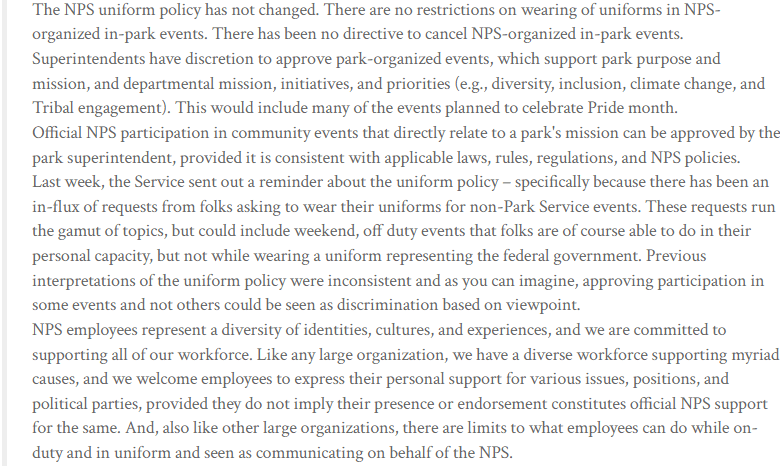
I reached out to an NPS spokesperson for clarification on whether the agency would continue participating in major city Pride events this year, as it has in previous years. The spokesperson responded that the policy “had not changed,” noting that “previous interpretations of the uniform policy were inconsistent” and that approving participation in some events while denying others could be perceived as “discrimination based on viewpoint.” While the spokesperson confirmed that in-park Pride events have not been canceled, they did not clarify whether NPS employees would continue to participate in major U.S. city Pride parades or celebrations. Attempts to follow up on this question went unanswered.
The characterization of Pride as a potentially “political” event raises concerns, particularly given the founding documents of Stonewall National Monument, which directly reference the “resources and values” of the LGBTQ+ community. NPS resources currently available on the site encourage people to “Celebrate Pride” and emphasize that “The LGBTQ experience is a vital facet of America’s rich and diverse past.” The resource underscores the importance of not making LGBTQ+ people invisible, stating, “By recovering the voices that have been erased and marginalized, the NPS embarks on an important project to capture and celebrate our multi-vocal past.” By barring employees from wearing Pride symbols or participating in Pride events, the NPS may unintentionally appear to be erasing and marginalizing its LGBTQ+ employees—contradicting its own stated mission.
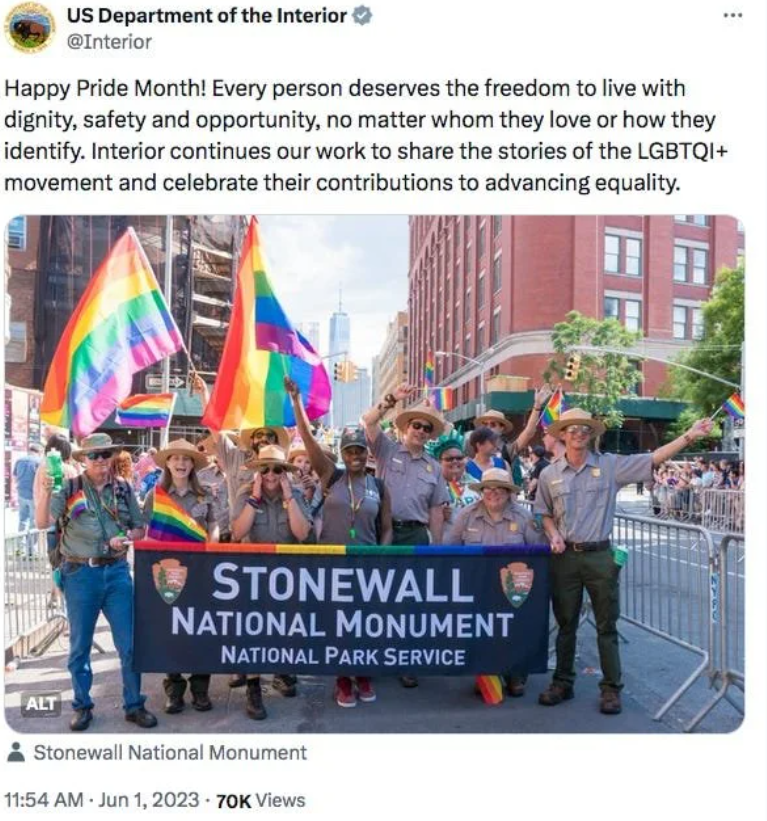
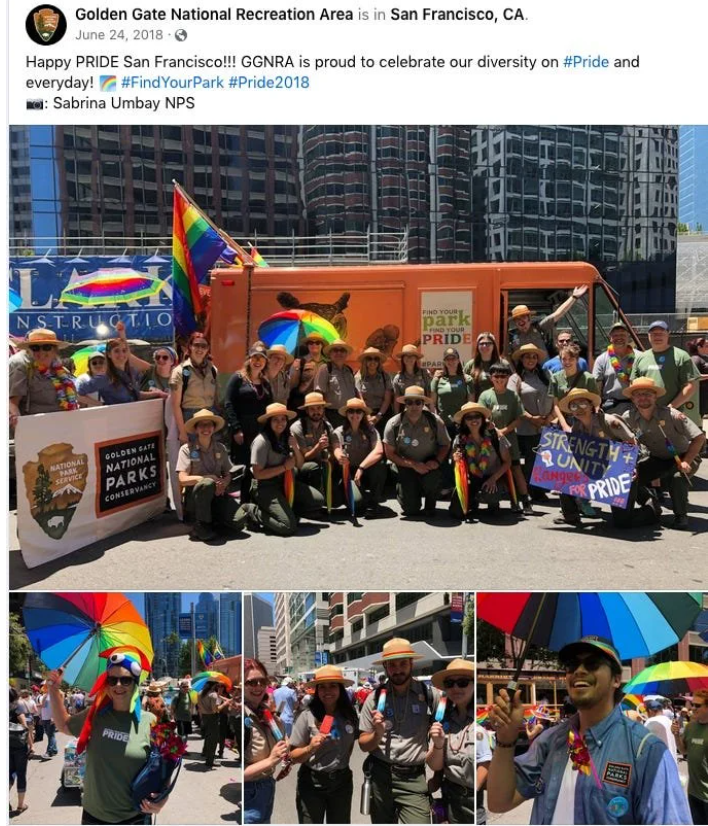
National Park Service employees have marched in uniform in Pride parades for years. In 2014, for example, Christine Lenhertz, a member of the NPS, requested permission for a group of LGBTQ+ park employees to wear their uniforms while participating in a Pride parade. Initially denied, the group filed a complaint, prompting a ruling from the Office of the Solicitor for the Department of the Interior, which determined there was no reason to prevent them from marching in uniform. Since then, NPS contingents have regularly participated in Pride events across the country.
The future of Pride parade participation for NPS employees in uniform remains uncertain. While it seems that some Pride events within National Parks, like those at Stonewall, may still take place, external participation in major city Pride events appears to be on hold in at least some locations across the U.S. The possibility of individual or smaller LGBTQ+-affiliated Park Ranger contingents joining city Pride celebrations looks even less likely, with little hope of approval for participation.
You can read the full response from an NPS spokesperson to the request for comment here:
 fleeredstates.blog
Leave a comment