
Read more at LGBTQ Nation.
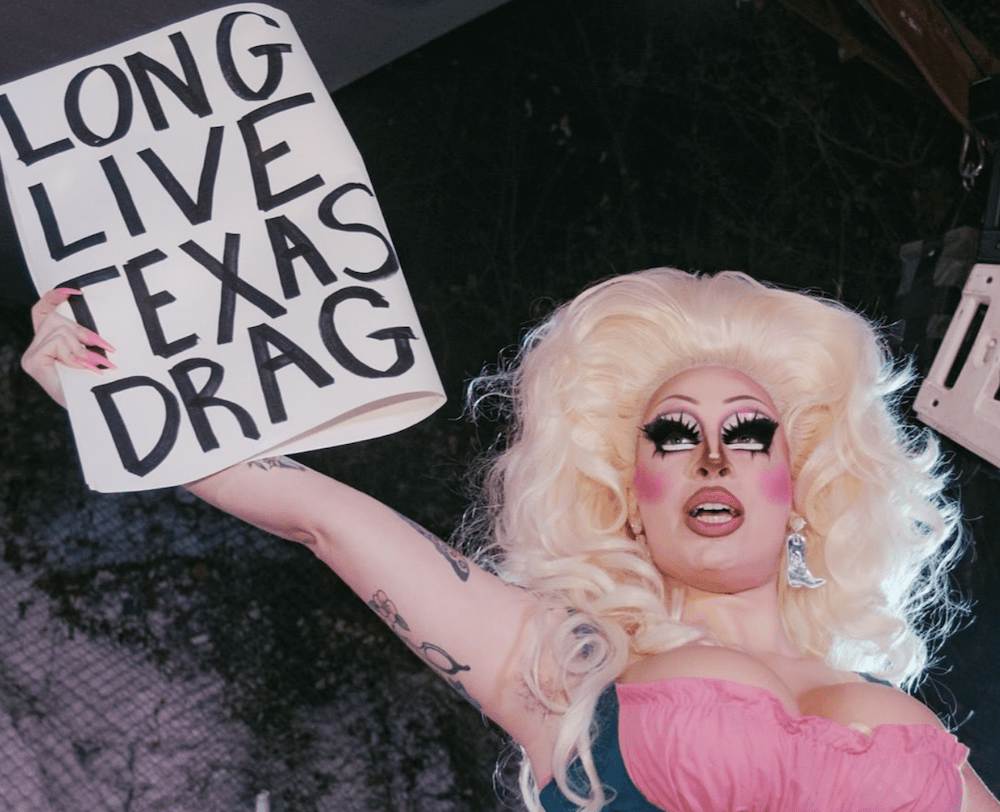
A federal judge in Texas ruled this week that the state’s drag ban is an unconstitutional restriction of free speech in violation of the First Amendment.
US District Court Judge David Hittner’s Tuesday decision strikes down S.B. 12, a 2023 law signed by anti-LGBTQ+ Gov. Greg Abbott (R). While the law does not explicitly mention the word drag, it criminalized “sexually explicit” performances in the presence of minors, defining such performances as those featuring “a male performer exhibiting as a female, or a female performer exhibiting as a male, who uses clothing, makeup, or other similar physical markers and who sings, lip syncs, dances, or otherwise performs before an audience.”
Under the law, businesses that host all-ages drag shows faced up to $10,000 in fines, and performers could be charged with a Class A misdemeanor resulting in up to one year in prison.
S.B. 12 was initially scheduled to take effect on September 1, 2023. But several LGBTQ+ advocacy organizations and drag groups — including The Woodlands Pride, Abilene Pride Alliance, and 360 Queen Entertainment — challenged the law. In September 2023, Hittner issued a permanent injunction blocking enforcement of the law, ruling that it constituted “viewpoint discrimination” and that it was “substantially overbroad” and “unconstitutionally vague.”
After Texas appealed the decision, the US 5th Circuit Court of Appeals overturned Hittner’s permanent injunction last November, sending the case back to the lower court and instructing Hittner to focus only on the claims from 360 Queen Entertainment. The appeals court’s ruling also allowed the law to go into effect while the case played out.
On Tuesday, Hittner once again ruled that S.B. 12 “is an UNCONSTITUTIONAL restriction on speech” that “violates the First Amendment,” even under the conditions the 5th Circuit outlined, according to The Texan.
The law, Hittner wrote, “applies to countless protected performances that might contain elements that are ‘in some sense erotic’ and meet either the law’s definition of ‘nude’ or ‘sexual conduct’ but are not obscene or obscene for minors and are thus constitutionally protected.” Hittner cited examples including a gymnast performing in a leotard and a singer performing in a lowcut dress.
As NBC News notes, Hittner went so far as to cite the late Dolly Parton, an LGBTQ+ ally who supported drag performers and even gifted a rhinestone guitar to drag performer and advocate Brigitte Bandit, one of the plaintiffs in the case, as an example of a performer who might be targeted by the law for her reputation “as a voluptuous sex symbol because of her big hair, flamboyant clothes and breast exposure.”
Hittner further ruled that “S.B. 12 is unconstitutionally vague because it fails to give a reasonable person notice of what is prohibited.” While “multiple aspects of the law render it vague,” Hittner wrote, the “most glaring issue” relates to the inclusion of the term “prurient interest in sex.” The fact that the term “is undefined in Texas law, lacks a readily ascertainable ordinary meaning, and applies to all performances targeted by the statute,” Hittner wrote, “renders S.B. 12 irredeemably vague… in violation of the Fourteenth Amendment’s Due Process Clause.”
“Finally, for those who find such activities as described in this case offensive, the solution is relatively simple,” Hittner wrote. “Just don’t go.”
In several Instagram Stories posts Tuesday, Bandit responded to Hittner’s ruling, writing that “drag is free speech b—-” and that the decision “is a huge win for Texas and my t——.”
Meanwhile, Texas Attorney General Ken Paxton (R), who is running for US Senate, described Hittner’s ruling as “a profoundly flawed decision that endangers our children and is an affront to Texas values.”
“I will appeal this decision immediately and continue to fight to protect our kids,” Paxton wrote in an X post.


Leave a Reply