
Read more at Prism.
Since the Trump administration took office in January, it has launched a sweeping attack on LGBTQIA+ people, and particularly on trans rights. In January, President Donald Trump signed an executive order designed to ban trans service members from the military. He has also attempted to prevent trans, nonbinary, and intersex people from obtaining passports with accurate gender markers and tried to withhold funds from hospitals that provide gender-affirming care to trans youth.
These and other attacks have drawn lawsuits and been the subject of conflicting and ongoing court rulings. The result is that trans people and queer people face a bewildering, frightening, and chaotic legal landscape when they try to negotiate health care, travel, veterans’ benefits, education, employment, or just existence. Accessing resources, or even determining whether they can exist, can be difficult and disheartening.
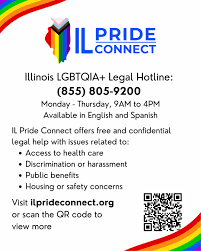
Illinois, in partnership with numerous state LGBTQIA+ organizations, is attempting to help. In August, the state launched Illinois Pride Connect, a legal resource hotline for queer people. The initiative was launched with $250,000 from the state and another $100,000 in private donations; it includes a website and a legal hotline—(855) 805-9200—which is available Monday through Thursday, 9 a.m. to 4 p.m. CT.
According to Gov. J.B. Pritzker, Illinois Pride Connect makes Illinois “the only state in the nation to provide free legal advice and advocacy tools to protect the LGBTQ community.”
Illinois Pride Connect is led by the state’s Department of Human Services and the Legal Council for Health Justice (LCHJ), which runs and staffs the hotline. LCHJ Executive Director Julie Justicz said her organization began discussing the need for a resource hub last spring.
“We were getting an increased number of calls from community members who were concerned about the number of executive orders that were coming down, impacting LGBTQ families in Illinois,” she told Prism. The organization was fielding more and more calls about gender-affirming care, education, and passports. “We talked with these other partner groups and decided that it would be good to establish an up-to-date, well-vetted hub of information.”
The state and other LGBTQIA+ organizations got on board quickly, and the resource hub launched in the summer. Justicz said LCHJ has five or six of its 30 staff members working extensively on the hotline. The website has had around 8,800 hits, and the staff receives two or three calls a day. She noted that the hotline also gets some calls from out of state, as LGBTQIA+ people and families consider moving into Illinois.
LCHJ is aware that people using the Illinois Pride Connect hub may be in a vulnerable position. The website offers a quick escape option in case someone does not want others to know they are seeking information on LGBTQ issues. Callers are also anonymous to protect them, though Justicz was able to provide Prism with descriptions of some conversations.
One caller to Illinois Pride Connect, according to the caller description, was “a parent of a trans adolescent seeking information on the risks and benefits of applying for a passport to reflect her child’s gender identity.” The family had updated birth certificates and state ID but had not changed their passport or Social Security record, and was worried about trying to get through customs with inconsistent gender information. Pride Connect was able to provide “detailed information on the current federal policies on gender marker changes to vital records, and on the Orr v. Trump court case concerning the State Department’s gender marker policy,” a staff attorney with LCHJ’s trans health law program said in an email.
Another caller was “a veteran living in rural IL who could no longer access transition-related medical care through [Veteran Affairs] and Tricare,” said the attorney, who requested to remain unnamed due to safety concerns about harassment and doxxing. The veteran was trying to determine if she could access Medicaid or other health insurance. Illinois Pride Connect provided information about Medicaid coverage in the state and referred her to local providers. This was especially helpful since the veteran had not been aware that local services were available.
Mike Ziri, the director of public policy at Equality Illinois, an organization on the Pride Connect Steering Committee, told Prism, “We get frequent requests for legal support, and those requests have accelerated in the last few years, particularly this year.”
Equality Illinois is a lobbying and civil rights organization; it doesn’t provide individual legal advice. So, Ziri said, “having a resource like Illinois Pride Connect—it’s great, it’s important, it’s critical.”
In the past, he said, Equality Illinois might have scrambled to connect people with someone at the Department of Human Rights or to another partner who might provide legal services. But, he said, “having a dedicated hotline … fills that gap.”
Kaitian Healey, gender diverse navigation specialist at Central Illinois Friends in Peoria, told Prism that he had found out about Pride Connect after it launched.
“Our organization was not listed as a health care provider that offered gender-affirming care and LGBT, plus care. So I was a little offended.” He reached out to Pride Connect, and Central Illinois Friends was quickly added to the steering committee.
“I work a caseload of about 100 folks that are accessing gender-affirming care,” Healey said. “And we do know of at least two clients” who reached out to Pride Connect for advice on navigating legal resources. Central Illinois Friends is an organization that focuses on health care, including sexual health testing, gender-affirming care, and mental health counseling. Illinois Pride Connect allows the group to easily direct the populations they serve in the central part of the state—including Peoria, Bloomington-Normal, and Galesburg—to resources that Central Illinois Friends does not provide directly.
Justiecz said that LCHJ is exploring an afterhours option so that people can leave legal questions when the hotline is not in operation and receive callbacks. As for the future, she said, they are looking to secure funding to sustain the initiative through the next two or three years at least under the current administration. After that, she said, the group will try to assess “are things getting worse for the community where they need this more?”
Right now, there’s no question that the resource is needed.
“We have challenges,” Ziri of Equality Illinois told Prism. “But the values of our state are equality, inclusion, and justice. And this project is just one way those values are manifested.”
 fleeredstates.blog
Leave a comment